
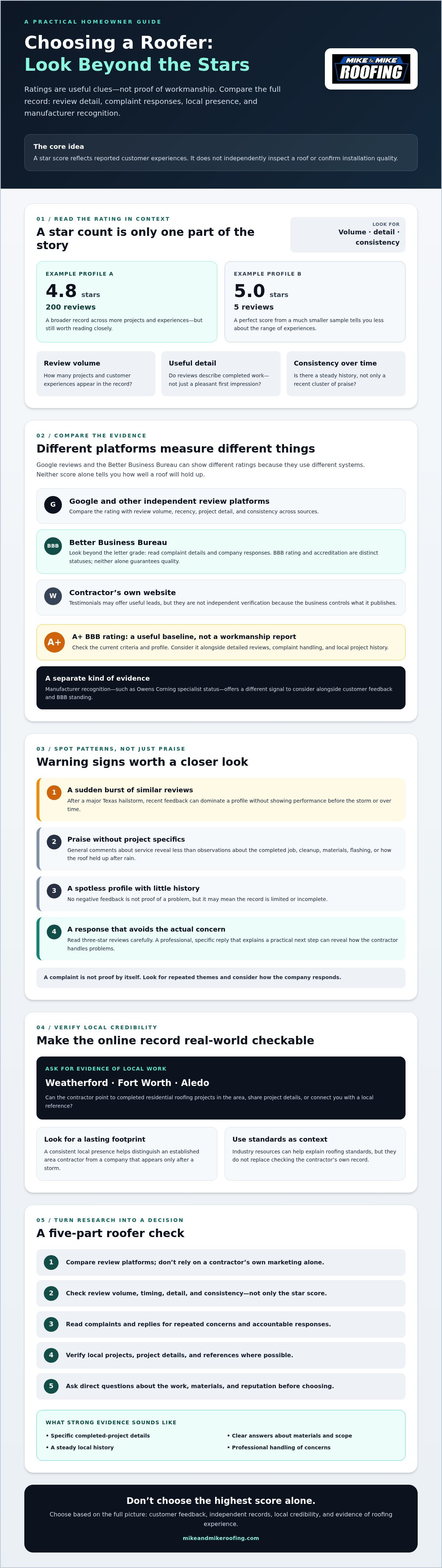
The roofer with the most stars may not be the safest choice. After a Texas storm, polished profiles and glowing reviews can make it hard to distinguish a proven local contractor from a storm chaser. Roofing contractor ratings are useful, but only when you understand what each score measures and what it leaves out.
It’s reasonable to compare Google reviews with the Better Business Bureau, then wonder why the ratings don’t match. They use different systems, and neither score alone proves how well a roof will hold up over time. A stronger check looks at the full picture: whether the contractor has a legitimate local reputation, how they respond to concerns, and whether manufacturer recognition supports their experience with roofing materials. An A+ BBB rating is a useful baseline; Owens Corning specialist status offers a separate kind of evidence.
This guide explains how to compare review platforms, spot warning signs, check local credibility, and understand where manufacturer recognition fits into your decision. The goal is a practical framework for choosing a roofer with confidence, not just a high star count.
Key Takeaways
- Read roofing contractor ratings in context. Review volume, detail, and consistency can matter more than a perfect star score.
- Compare review platforms and look for independent verification instead of relying on a contractor’s own marketing.
- Watch for sudden bursts of similar reviews, especially after a storm, and check whether the contractor has a lasting local presence.
- Consider manufacturer recognition alongside customer feedback and BBB standing.
- Turn online research into direct questions about the work, materials, and reputation before choosing a roofing partner.
Decoding Roofing Contractor Ratings: More Than Just a Star Count
A roofing contractor rating is a snapshot of customers’ reported experiences. It may reflect communication, scheduling, workmanship, cleanup, and how problems were handled. Ratings can help you screen contractors, but they don’t independently inspect a roof or confirm the quality of an installation. For context on the trade itself, see what a roofer does, then look for evidence of how the contractor performs that work.
A 4.8-star rating backed by 200 reviews can offer a broader record than a 5.0 based on only five reviews. The larger sample includes more projects and a wider range of experiences, but it still deserves a close read. Consider review volume, recency, and whether customers describe completed projects in enough detail to be useful.
Pay attention to recency bias, too. After a major Texas hailstorm, a wave of new customers may post reviews within a short period. Those comments can dominate a contractor’s profile without showing how the company performed before the storm or over time. Look for a steady history alongside recent feedback, not just a sudden cluster of praise.
The Difference Between Customer Service and Workmanship
A friendly salesperson can make a strong first impression and earn a five-star review before the roof has faced its first hard rain. Look for project details that speak to the work itself. Was the job site left clean? Did the crew address flashing, the material used around roof joints and edges? Does the homeowner mention whether the roof stayed leak-free after rain? Specific observations give you more to assess than a general “great service.”
Price and value ratings also need context. Exterior work is project-based, and fees reflect the agreed scope, materials, and work involved. A review calling a job “expensive” doesn’t tell you whether the proposal was fair or comparable. Compare the scope and outcome described, not price impressions alone.
Why “Perfect” Scores Can Sometimes Be a Warning Sign
Construction work has moving parts, and mistakes or misunderstandings can happen. What matters is whether the contractor responds clearly and works toward a reasonable resolution. A profile with no negative feedback isn’t proof of a problem, but it may reflect a limited track record or a feedback record that doesn’t show the whole picture.
Read any three-star review carefully, then assess the contractor’s reply. Does it address the specific concern, stay professional, and explain a practical next step? A calm, accountable response can tell you more about how a company handles problems than a string of vague five-star comments.
Evaluating the Platforms: Where to Find Reliable Roofing Reviews
No single review site can prove a roofer’s workmanship. Use a layered check: start with third-party records, such as the Better Business Bureau (BBB), then compare reviews on independent platforms. Treat testimonials on a contractor’s own website as useful leads, not independent verification, since the business controls what it publishes. Across platforms, look for specific, consistent accounts instead of relying on a star score alone.
Use the BBB to examine more than the letter grade. Read complaint details and the company’s responses, and note repeated themes, such as unresolved communication problems or similar concerns about completed work. A complaint isn’t proof by itself; the pattern and response matter. The BBB’s rating and accreditation are distinct, so check what each status means rather than assuming one guarantees quality.
Online records also need a local reality check. Ask whether the contractor can point to completed residential roofing projects in Weatherford, Fort Worth, or Aledo, and whether you can see project details or speak with a local reference. A consistent local footprint helps establish that a company has a presence in the area, rather than appearing only after a storm. The industry standards and educational resources from the National Roofing Contractors Association can add context, but they don’t replace checking a contractor’s own record.
The Weight of an A+ BBB Rating
An A+ BBB rating is a useful baseline, not a complete workmanship report. Review the BBB’s current rating criteria and the contractor’s profile, including its record of handling complaints and any applicable business information. Mike and Mike Roofing has an A+ BBB rating, a third-party signal homeowners can consider alongside detailed reviews and local project history. For a broader vetting checklist, read about trusted exterior contractors.
Manufacturer Certifications: A Professional Rating
Manufacturer recognition adds a different kind of evidence than customer reviews. Mike and Mike Roofing is an Owens Corning roofing specialist. Treat that designation as a professional signal, then confirm the current tier and its requirements directly with the manufacturer. Certification criteria and warranty options can vary, so don’t assume a designation guarantees a particular warranty or outcome. Review the written terms for any proposed residential roof installation.
These checks work best together: third-party records for transparency, local projects for evidence of presence, and manufacturer status for professional context. If you’re comparing contractors around Weatherford, Fort Worth, or Aledo, Mike and Mike Roofing’s roofing contractor ratings and credentials can be one point of reference in your research.
How to Spot Misleading Ratings and "Review Padding"
A review profile can look impressive and still tell only part of the story. Treat roofing contractor ratings as clues to investigate, not proof that every comment is genuine or that the work will suit your home. Look for patterns across review dates, reviewer histories, project details, and the contractor’s local footprint.
Identifying Fake or Incentivized Reviews
Repeated wording, generic praise, and reviewer profiles with little history deserve a closer look. They aren’t proof of fraud on their own, but they offer little evidence of a real roofing project. Be cautious if a company appears to offer a discount specifically for a five-star review. Review platforms may prohibit incentives or require disclosure. A sudden wave of unrelated negative posts can also distort a rating. Check the details and timing before assuming the feedback reflects verified customer experiences.
Use this quick checklist when scanning a contractor’s profile:
- Look for specifics: Do reviewers describe the project, materials, communication, cleanup, or how concerns were handled?
- Compare phrasing: Do several reviews repeat the same unusual wording or offer only “Great job!” without context?
- Check reviewer history: Does the reviewer appear to have a broader history of activity, or only one review?
- Study the timing: Did reviews arrive steadily, or cluster tightly around a hailstorm or other event?
- Verify the local connection: Can the company’s address and project history be corroborated in the area it claims to serve?
The Problem with Aggregate Score Gaming
A perfect average can hide important details. Sort by three- and four-star reviews to find measured accounts that may explain both what went well and what could have gone better. Matter-of-fact feedback about scheduling, materials, or communication is often more useful than generic praise. Also check whether the company responds to criticism with specifics rather than arguing or posting a canned reply.
Material references can help you assess whether a review describes a relevant project. A homeowner who mentions Owens Corning shingles or Hardie board siding, for example, gives you something concrete to compare with the contractor’s stated experience. Brand names alone don’t verify a job, however, and shouldn’t be treated as proof of installation quality.
Consider a hypothetical warning sign: after a hail event, a contractor’s profile gains 50 reviews in one month, many with similar wording, then the company becomes difficult to find locally. That pattern calls for more checking, not an automatic verdict. Confirm the physical address, look for a history of local projects, and ask for references tied to work in Weatherford, Fort Worth, or nearby communities. A contractor with a real local track record should be able to discuss completed projects clearly.
Local Ratings Strategy: Vetting Weatherford and Fort Worth Contractors
In North Texas, hail can bring a rush of roofing ads, new reviews, and contractors from outside the area. That makes local history worth checking alongside online ratings. A contractor with an established presence in Weatherford, Aledo, or Fort Worth may have a reputation built through completed work and ongoing community relationships, not just a profile that appears after a storm.
There’s no reliable “three-year rule” that proves a roofer is dependable. Instead, look for a consistent record over time. Check whether the business address and contact details match across its website, review profiles, and public business records. Ask for references connected to local projects, and confirm insurance directly with the contractor. Texas has no statewide roofing license, so check applicable city requirements rather than assuming a countywide credential applies. A sign in a neighbor’s yard can be a useful lead, but it isn’t a workmanship guarantee.
Local Experience After a Storm
A contractor familiar with the area may understand the questions homeowners face after hail, but local status doesn’t prove a roof has storm damage or that replacement is necessary. Ask for a clear explanation of any concerns, supporting observations, and recommended next steps. Information about evaluating a contractor’s approach to a roof inspection for storm damage can guide your questions, but it doesn’t replace checking the contractor’s credentials and record.
Ask the Neighborhood
Local Facebook groups and Nextdoor can surface candid recommendations that don’t appear on review platforms. Treat posts as starting points: ask whether the person hired the contractor, what work was done, and how the company handled questions afterward. If you see a Mike and Mike Roofing sign nearby, consider it an invitation to ask the homeowner about their experience, not an automatic five-star verdict. For siding work, ask separately about communication, installation, and follow-through, and compare accounts with this guide to siding installation service.
Ratings don’t always transfer between trades. A strong roofing record doesn’t establish how a contractor performs on siding or window installation. Look for reviews that describe the specific work you need, and ask neighbors about that same type of project. That’s a more useful local check than relying on one overall score.
For a local point of comparison, review Mike and Mike Roofing’s residential roofing information and ask questions that help you judge the company’s local track record for yourself.
Turning Ratings into Reality: Selecting Your Roofing Partner
Online research can narrow your choices, but a conversation shows how a contractor communicates about your home and the work you’re considering. Set up a meeting, share what you’ve noticed, and ask for an explanation of the proposed scope. Roofing contractor ratings help you form questions; the meeting helps you assess the answers.
Pay attention to the conversation. Does the representative arrive when agreed, listen before recommending work, and explain technical details in plain language? If they point out a concern, ask what they observed and how it affects the roof. A trustworthy professional should be willing to answer questions without turning uncertainty into pressure. Consider your impression, but weigh it against the facts you’ve checked.
A Straight-Shooter Approach
Mike and Mike Roofing is a father-son team with an A+ BBB rating and Owens Corning specialist status. Those are useful points to verify alongside the company’s local reviews and project history. Keep the conversation focused on your questions and the work being considered, rather than relying on big promises. Ask for a written scope so you can understand what’s included before making a decision.
Prepare for the Estimate
Before a roof or siding estimate, gather photos or notes about your concerns, list your questions, and clarify which areas of the home you want considered. Ask the contractor to explain the proposed work, materials, and any exclusions. A useful written estimate should make the scope clear, identify the materials being proposed, and explain the expected process and payment terms. Compare proposals on those details, not just the bottom line.
After the meeting, compare what you heard with what you found online. Did the representative answer directly? Did the written proposal match the conversation? Do the company’s claims align with verifiable credentials and reviews? The strongest choice balances evidence and trust, rather than relying on a star score or polished sales pitch alone.
If you’re ready to discuss a residential roofing or siding project, request an estimate from Mike and Mike Roofing.
Choose With Clear Eyes and Confidence
Reliable roofing contractor ratings are a starting point, not a final verdict. Look beyond the star average: compare review details, check a contractor’s local history, and consider professional credentials alongside customer feedback. Then bring your questions to a direct conversation and decide whether the answers and written scope make sense for your home.
Mike and Mike Roofing is a family-owned Weatherford business with an A+ BBB rating and Owens Corning roofing specialist status. These are useful signals to weigh with the rest of your research, not substitutes for asking questions and reviewing the proposed work.
If you’re considering a residential roofing project in Weatherford, Fort Worth, or Aledo, Get a Straight-Shooting Quote from Mike and Mike Roofing. Take your time, verify what you can, and choose the professional who earns your confidence through clear answers and a sound proposal.
Frequently Asked Questions
Are Google reviews for roofing contractors reliable?
Google reviews can help you spot patterns, but they aren’t a guarantee of workmanship. Check how many reviews a contractor has, when they were posted, and whether they describe specific projects, materials, or outcomes. Compare them with other independent sources, such as BBB records and local recommendations. For roofing contractor ratings around Weatherford, Fort Worth, and Aledo, look for consistent feedback across platforms rather than trusting one score.
What does an A+ BBB rating actually mean for a roofer?
An A+ BBB rating indicates the Better Business Bureau has assigned the business its highest letter grade under its rating system. It’s a useful trust signal, but it doesn’t certify roof quality, guarantee a project outcome, or replace checking reviews and references. BBB rating and BBB accreditation are not the same thing. Review the contractor’s BBB profile, including complaint details and responses, and consider it alongside other evidence.
How can I tell if a roofing contractor is a “storm chaser”?
Look for signs that the contractor appeared in your area after a storm but has little verifiable local history. Check whether its address and contact information are consistent, ask for references from completed projects nearby, and look for reviews spread across time rather than a sudden burst. Be cautious of pressure to sign quickly or promises that sound too good to be true. Verify insurance and written project details before agreeing to work.
Should I trust a roofer with a few 1-star reviews?
A few 1-star reviews don’t automatically mean a contractor is unreliable. Read what each reviewer says, check whether complaints describe a repeated issue, and see how the company responds. A clear, professional reply that addresses the concern can be informative; hostility or repeated unanswered complaints deserve closer scrutiny. Compare critical reviews with the broader record, including detailed positive feedback, local references, and any relevant BBB complaint history.
Do manufacturer certifications like Owens Corning affect a contractor’s rating?
Manufacturer recognition can add useful professional context, but it’s separate from customer ratings. Mike and Mike Roofing is an Owens Corning roofing specialist. Confirm the contractor’s current designation and what it covers with the manufacturer, since tiers and requirements may vary. A designation isn’t a promise of a particular installation result or warranty. Review the written project scope and applicable warranty terms, then weigh that information alongside customer reviews and local references.
How do I verify if a roofing contractor is truly local to Weatherford?
Check that the company’s address and contact details match across its website, business profiles, and other records. Ask for references tied to completed projects in Weatherford, Fort Worth, or Aledo, and look for a steady history of local reviews rather than a profile that surfaced after a storm. You can also ask nearby homeowners about their experience. A local address is a starting point, not proof of reliable work.
What should I do if a contractor has no online ratings?
No online ratings don’t prove a contractor is unqualified, but they leave less public feedback to assess. Ask for local customer references and examples of relevant completed projects, then verify the business address and insurance information. Review the written proposal carefully and ask direct questions about materials, scope, and who will carry out the work. If the contractor can’t provide clear answers or reasonable ways to verify its record, compare other options.
Is a higher price always a sign of a higher-rated contractor?
No. A higher quote doesn’t automatically mean better materials, workmanship, or service. Compare proposals by scope, specified materials, project details, and exclusions, not just the total price. Ask each contractor to explain differences in writing so you can make a fair comparison. Reviews can reveal reported customer experiences, but they don’t establish whether a quote is appropriate for your home. Choose the proposal you understand and can verify, not simply the most expensive one.


