
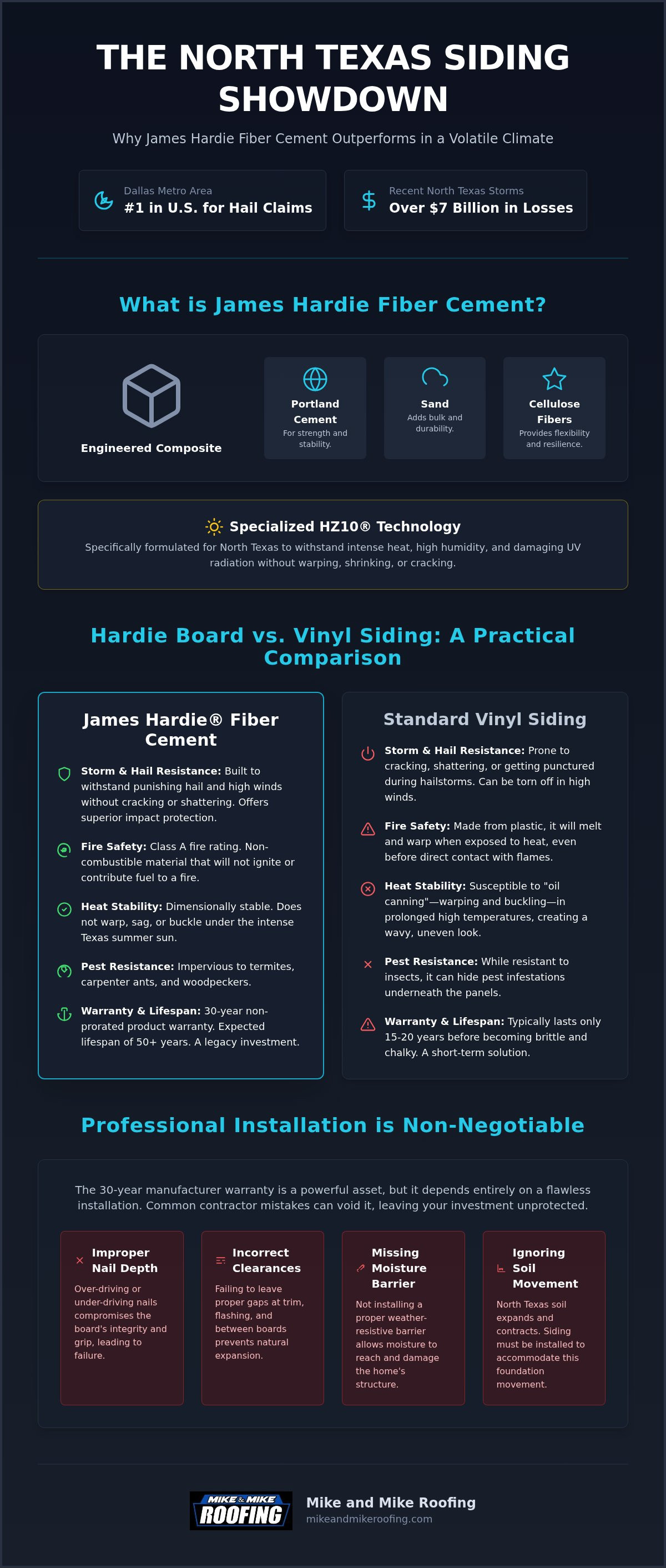
Dallas is the most hail-claimed metropolitan area in the United States, with recent storm cycles causing over $7 billion in insured losses across North Texas. For local homeowners, the exterior of your house is the only thing standing between your family and the next volatile weather event. You might be considering a hardie board siding installation to upgrade your curb appeal, but your real goal is likely finding a solution that lowers energy bills and stands up to punishing hail. It's a big decision, especially when insurance deductibles are rising and the fear of high maintenance costs feels constant.
We've seen firsthand how the right materials can transform a property from a liability into a fortress. This guide will show you why James Hardie products are the gold standard for our region and how professional installation protects both your property and your 30-year manufacturer warranty. We'll walk through the specific benefits of fiber cement, from impact resistance to long-term durability, and explain the precise steps required to ensure your siding lasts for decades. You'll gain the confidence to make an informed choice that keeps your home beautiful and secure for the long haul.
Key Takeaways
- Learn how HZ10 technology is engineered to withstand the intense North Texas heat and UV exposure that degrades lesser materials.
- Compare the long term value of fiber cement against vinyl to see how a 50 year lifespan justifies the initial investment.
- Discover why a precise hardie board siding installation requires specific moisture barriers and specialized tools to protect your home's structural integrity.
- Avoid the common technical mistakes, such as improper nail depth or clearance gaps, that can void your 30 year product warranty.
- Understand how local soil expansion affects your home's movement and why your contractor must account for these shifts during the build.
What is Hardie Board Siding? Understanding Fiber Cement
James Hardie didn't just create a product; they pioneered an entire category. When we talk about Understanding Fiber Cement, we are looking at a composite material engineered from Portland cement, sand, and cellulose fibers. It's built for stability. For homeowners in our area, the brand developed HZ10 technology. This isn't marketing fluff. It's a specific formulation designed to withstand the high temperatures and intense UV radiation we see every summer in North Texas. A professional hardie board siding installation provides a level of protection that other materials simply cannot match. It won't rot like wood, it won't melt like vinyl, and it won't burn. It's a straight-shooter's choice for long-term security.
The Composition of Durability
The strength of this material comes from its specific ingredients. By combining heavy-duty cement with cellulose fibers, the boards become virtually impenetrable to common North Texas nuisances. Termites, carpenter ants, and woodpeckers that usually make quick work of cedar or pine find no purchase here. You have two main options for the finish: ColorPlus Technology or field-primed boards. ColorPlus involves a factory-applied finish that is baked on to resist fading and chipping. Field-primed boards are ready for custom paint once the hardie board siding installation is complete. Compared to the fragility of traditional wood, fiber cement offers a rugged reliability that handles our climate without warping, shrinking, or cracking under the sun.
Why HardiePlank is the Industry Standard
HardiePlank lap siding is the most popular choice for a reason. It provides the timeless look of traditional cedar siding but removes the constant cycle of scraping and staining. Whether you own a classic ranch home in Weatherford or a modern build in Aledo, the architectural versatility is unmatched. It fits the local aesthetic perfectly while providing a barrier that stands up to heavy rain and wind. The material is thick and heavy, giving your home a premium feel that flimsy alternatives lack. Hardie Board serves as the steadfast protector of the home's structure. It ensures the bones of your house stay dry and secure regardless of what the Texas sky throws at it. This combination of beauty and brawn is why it remains the gold standard for residential exteriors.
Hardie Board vs. Vinyl Siding: A Practical Comparison
Let's address the elephant in the room: the initial price tag. A hardie board siding installation requires a larger upfront investment than vinyl. There's no sugarcoating that reality. But looking only at the day-one cost is a short-sighted move for homeowners in Aledo or Fort Worth. Vinyl siding is essentially a plastic shell. After 15 years of Texas sun, it's often brittle, chalky, and ready for the landfill. Hardie Board is a legacy product. It's built to protect your home for 30 to 50 years. When you factor in the curb appeal ROI and local resale values, the fiber cement option usually wins the long game.
Texas heat creates a unique set of problems for exterior finishes. Vinyl panels often warp or "oil can" when the thermometer stays in the triple digits for weeks at a time. Hardie Board remains dimensionally stable. It doesn't sag or buckle under the summer sun. This stability keeps your home's lines clean and professional for decades, maintaining the premium look your neighborhood expects.
Performance in Storms and Fire
Hardie Board carries a Class A fire rating. This means it won't ignite or act as fuel if a fire breaks out nearby. Vinyl lacks this protection and can actually melt away from the wall before a flame even touches it. We also have to consider our local hail. While vinyl often shatters or cracks during a North Texas storm, fiber cement is dense enough to take the hit. It stays secured to the studs in high winds that would peel vinyl right off the house. This rugged reliability is why many insurance carriers prefer fiber cement in storm-prone regions.
Maintenance and Long-Term Costs
The idea that vinyl is "maintenance-free" is a common misconception. You might not paint it, but you can't easily fix it when it fails. Hardie Board with ColorPlus Technology typically only needs a fresh coat of paint every 15 years. As of 2026, these products come with a 30-year, non-prorated warranty that protects your investment. If you look at the home siding installation cost over a 30-year span, the "cheaper" vinyl often ends up costing more in repairs and replacement. Five Texas summers are usually enough to make a cheap siding job look its age.
If you want a straight-shooting estimate on a permanent solution for your exterior, we're here to help. Choosing the right material is about long-term security, not just the lowest bid.
The Professional Hardie Board Installation Process
Precision is mandatory. A successful hardie board siding installation depends on what happens before the first plank is ever leveled. We don't just slap it on. We follow a methodical sequence to ensure the entire system performs as designed for the next thirty years. If you skip the foundational steps, the most expensive siding in the world won't protect your home from a Texas thunderstorm.
Preparation and the Weather Barrier
The house wrap is your second line of defense. Even the best siding can't stop 100% of wind-driven rain. This barrier ensures that any moisture that manages to sneak behind the boards drains away safely rather than soaking into your wall studs. We pay special attention to the openings. Every window and door gets sealed with high-performance flashing tape to create a total exterior seal. This is the perfect time to evaluate your window installation service needs, as these two systems must work together to keep your home bone-dry.
Precision Cutting and Fastening
Fiber cement is tough on tools. We use circular saws equipped with diamond-tipped blades for non-jagged, factory-clean edges. To keep the job site clean and safe during a professional hardie board siding installation, we often utilize specialized siding shears. These tools cut the material without creating the hazardous silica dust associated with traditional sawing. It's a cleaner way to work that respects your property and our crew's health.
For the fastening, we use a blind nailing technique. We drive nails through the top of the board, which are then covered by the overlap of the next course. This results in a clean, fastener-free aesthetic that looks premium from the curb. We only use hot-dipped galvanized nails. Standard steel nails will eventually corrode, leaving permanent, ugly rust streaks down your new facade. We also prioritize joint flashing over simple caulking at the butt joints. Caulk eventually dries out and fails, but metal flashing provides a permanent, mechanical solution for water management.
Finally, we respect the clearances. James Hardie requires specific gaps from roof lines, decks, and the ground. For example, siding must stay at least two inches above roof shingles. This prevents the material from wicking moisture and ensures proper ventilation. If these gaps are missing, your investment is at risk and your warranty may be voided before the job is even finished.
Critical Mistakes That Void Your Hardie Warranty
A 30-year warranty is a powerful promise, but it's only as good as the crew hanging the boards. James Hardie maintains strict installation standards. If your contractor ignores them, the manufacturer won't cover a dime of the damage. The #1 mistake we see during a hardie board siding installation is improper nail gun depth. If a nail is over-driven, it shatters the fiber cement core and loses its holding power. If it's under-driven, the board will rattle and eventually work itself loose. Both errors are grounds for a denied warranty claim.
Joint management is equally vital. You cannot simply jam boards together. Fiber cement requires specific gaps to allow for thermal expansion and contraction. If the joints are too tight, the siding will buckle and bow when temperatures spike. We also see many installers using standard painter's caulk. You must use a high-grade elastomeric sealant that remains flexible. Cheap caulk dries out and cracks within a few Texas summers, leaving your home's structural framing vulnerable to moisture.
Improper Clearances and Water Damage
The "2-inch rule" is non-negotiable for any roof-to-wall intersection. Siding must maintain a two-inch gap above the shingles to prevent moisture wicking. If the boards touch the roof, they act like a sponge, drawing water up into the material and causing it to swell or delaminate. We also require at least six inches of clearance from the finished grade. Kick-out flashing is another mandatory component that many "fast" crews skip. It directs roof runoff away from the siding and into the gutter system. Skipping these small parts might save a contractor ten minutes, but it will cost you thousands in the long run.
The Nailing Pattern Myth
Nails must penetrate the wall studs, not just the OSB sheathing. Fiber cement is a heavy material. Fastening it only to the plywood or "skin" of the house leads to a wavy appearance and a noticeable rattle during high winds. We view your home as a single, unified protective envelope. A residential roof installation and your siding must work together to seal out the elements. If one part of the system is failing, the other is at risk.
Protect your investment by working with a team that respects the manufacturer's rulebook. If you're ready for an exterior that lasts, reach out to us for a straight-shooting assessment of your home.
Why Local Expertise Matters for North Texas Siding
North Texas is famous for its expansive clay soil. This isn't just a foundation problem; it's a siding problem. As the ground swells and shrinks with our extreme weather cycles, your house moves. A generic contractor might follow a basic manual but miss the local nuance of how these shifts impact an exterior. A professional hardie board siding installation must account for this constant movement. If the joints are too rigid or the fastening is too stiff, the shifting soil will eventually cause the boards to bind, buckle, or crack. We've spent decades watching how homes in Weatherford and Aledo react to these environmental pressures.
Weatherford-Specific Climate Resilience
Our 100°F+ days create massive thermal stress on every square inch of your home's exterior. It isn't just about the fiber cement boards; it's about how the trim and sealants behave when the sun is relentless. We take a straight-shooter approach to every inspection we perform. Sometimes, what a homeowner thinks is storm damage is actually the result of poor original craftsmanship that failed to leave adequate expansion gaps. We look for these vulnerabilities during our initial walk-through. Being an A+ BBB rated local partner means we don't just finish a job and disappear. We live where we work. We know our reputation is only as good as the last house we protected from the next North Texas storm.
The Mike and Mike Commitment
Mike and Mike Roofing is a family-owned, father-son operation. We've built a legacy of rugged reliability across the Fort Worth area by prioritizing long-term security over quick profits. We don't believe in high-pressure sales tactics or corporate scripts that try to "close" you before you're ready. When you call us, you get an honest, blunt assessment of what your home actually needs. Our personality is rooted in being a neighborly advisor who values thoroughness over speed.
Our free estimate process is designed to be transparent. We'll walk the property with you, identifying potential moisture entry points and explaining the specific steps we'll take to seal your home's envelope. We take pride in being a steadfast protector of your property. If a hardie board siding installation is the right move for your investment, we'll tell you why. If it isn't, we'll be just as honest about that too. We are committed to doing things the right way rather than the easy way.
Request your free siding estimate from Mike and Mike Roofing today.
Protect Your Home with Confidence
Choosing the right siding is a big investment for your property. A hardie board siding installation offers durability that standard vinyl simply cannot match, providing a shield against North Texas hail and summer heat. However, the true value of fiber cement is only realized when the installation follows strict manufacturer guidelines. Skipping the 2-inch rule or using the wrong fasteners can turn a premium upgrade into a maintenance headache that voids your warranty.
We take pride in our role as local advisors for our neighbors in Weatherford. As a family-owned and operated operation with an A+ BBB rating and 5-star local reviews, we focus on transparency and elite craftsmanship. We've seen how our local climate and expansive soils test an exterior over time. Our goal is to provide a solution that looks premium today and remains stable for decades. If you're ready for a straight-shooting assessment of your home's needs, we're here to help.
Get a Free, Honest Siding Estimate from Weatherford’s Own Mike and Mike Roofing
Frequently Asked Questions
How long does Hardie Board siding installation take for an average home?
Typically, a full hardie board siding installation for an average-sized home in the Weatherford area takes between seven and fourteen days. The timeline varies based on the complexity of your home's architecture and current weather conditions. Because fiber cement is a heavy material that requires precise cutting and fastening, it takes longer to install than lightweight vinyl. We focus on getting the details right rather than rushing through the process.
Can Hardie Board siding be installed over existing wood or vinyl?
We don't install new siding over old wood or vinyl. To do the job right, we must strip the exterior down to the original sheathing. This allows us to inspect for hidden rot, pest damage, or structural issues that would otherwise stay buried. Starting with a clean, flat surface is the only way to ensure your new weather barrier and siding perform as intended for decades.
Is Hardie Board siding fireproof?
Hardie Board is non-combustible and carries a Class A fire rating, which is the highest level of fire protection available for siding. It won't ignite or act as fuel if a fire breaks out nearby. While no building material is entirely fireproof under extreme conditions, fiber cement provides a critical layer of safety that vinyl and wood simply cannot offer. It is a stable choice for protecting your family.
Do I need to paint Hardie Board siding after it is installed?
If you choose the ColorPlus Technology finish, your siding arrives with a baked-on color that doesn't require immediate painting. This finish is warrantied against peeling and cracking for 15 years. If you opt for pre-primed boards, you will need to apply a high-quality exterior paint after the hardie board siding installation is complete. Either way, you'll enjoy a finish that lasts much longer than traditional wood paint jobs.
What is the difference between HardiePlank and fiber cement siding?
Fiber cement is the general name for the composite material made of cement, sand, and cellulose fibers. HardiePlank is the specific brand of lap siding manufactured by James Hardie. It is the most recognized fiber cement product in the industry. We use it because their HZ10 technology is specifically engineered for the high heat and humidity levels we experience here in North Texas and the surrounding Fort Worth area.
How does Hardie Board hold up against North Texas hail storms?
Fiber cement is exceptionally dense and holds up very well against the hail storms common in Dallas and Weatherford. Unlike vinyl, which often shatters or cracks upon impact, Hardie Board is designed to resist damage from wind-driven debris. It provides a rugged exterior that maintains its structural integrity when the weather turns volatile. This durability is one reason many local homeowners choose it over flimsier alternatives.
Does Hardie Board siding increase my home's resale value?
Installing Hardie Board is a proven way to boost your home's resale value and curb appeal. Buyers in North Texas look for durability and low maintenance. When they see James Hardie products, they know the home is protected by a 30-year warranty. It's considered a premium upgrade that often yields a higher return on investment than other siding materials during the appraisal process in our local market.
Why is professional installation required for the James Hardie warranty?
The James Hardie 30-year non-prorated warranty is only valid if the material is installed according to their exact technical specifications. These rules cover everything from nail depth to specific clearances from your roof line. If an uncertified crew makes a mistake, the manufacturer can deny future claims. Professional installation ensures every detail is handled correctly, giving you the long-term security and peace of mind you expect for your investment.


