

What if the puddle beside your foundation isn’t a ground-drainage problem at all, but a downspout sending roof water to the wrong place? A loose connection, leak, blockage, or bent section can interrupt the drainage path. Gutter downspout repair starts with finding where water stops flowing as it should, not just patching the most visible spot.
Eroded soil, water pooling after rain, or a downspout hanging away from the house can all raise the same question: will a simple fix do, or does the drainage system have a bigger problem? This guide explains warning signs, common repair approaches, and when an issue needs a closer assessment. It also shows why the full route matters, from the gutter outlet to the point where water leaves the system.
Some problems are visible from the ground. Others may involve a hidden blockage, loose fasteners, or damage farther along the gutter. Learn what to look for, how to check safely, and when to leave the inspection to a professional. These steps apply to homes in Weatherford, Fort Worth, and Aledo as well as elsewhere.
Key Takeaways
- Look for leaking joints, detached sections, dents, overflow, or washed-out soil as possible signs of downspout trouble.
- Effective gutter downspout repair should restore the route from the gutter outlet to the discharge point.
- An isolated loose connection differs from repeated separation or widespread deterioration, which may involve more of the system.
- Check from the ground, note where water escapes, and don’t reach toward unstable or damaged gutter components.
- A thorough assessment considers the downspout, its gutter connection, and where runoff exits.
Gutter Downspout Repair: Signs Water Is Not Draining Properly
Gutter downspout repair addresses a damaged connection or component so roof runoff can follow its intended route, from the gutter outlet to a suitable discharge point. The part that looks faulty may not be the only issue. Water can escape because a joint has separated, a section has shifted, or flow is obstructed farther along the route. A What is a Downspout? reference explains the basic purpose of this pipe: carrying rainwater from the roof drainage system down and away from the building.
Look for clues such as:
- Water dripping or streaming from a joint while the downspout is carrying runoff.
- An elbow or pipe section that has pulled apart, or a strap that no longer holds the pipe against the wall.
- A dented, crushed, or displaced section that may interrupt the water route.
- Water spilling over the gutter outlet, or staining and washed-out soil below the discharge point.
Leaking joints, separated or distorted sections, overflow, and erosion below the outlet are reasons to inspect a downspout. Water discharging beside siding or close to the foundation deserves attention because repeated runoff in one spot can wet surfaces and disturb soil. That does not prove the home has sustained damage, but it does suggest that water may not be going where it should.
What does a damaged downspout look like?
A loose strap can let the pipe pull away from the wall. A separated elbow creates a visible gap where water may escape. A cracked seam can show as a narrow leak, while a crushed or displaced section may restrict or redirect flow. Staining or a small channel in the soil below an outlet can indicate that runoff is landing in the wrong place. No single symptom confirms the cause or the repair needed.
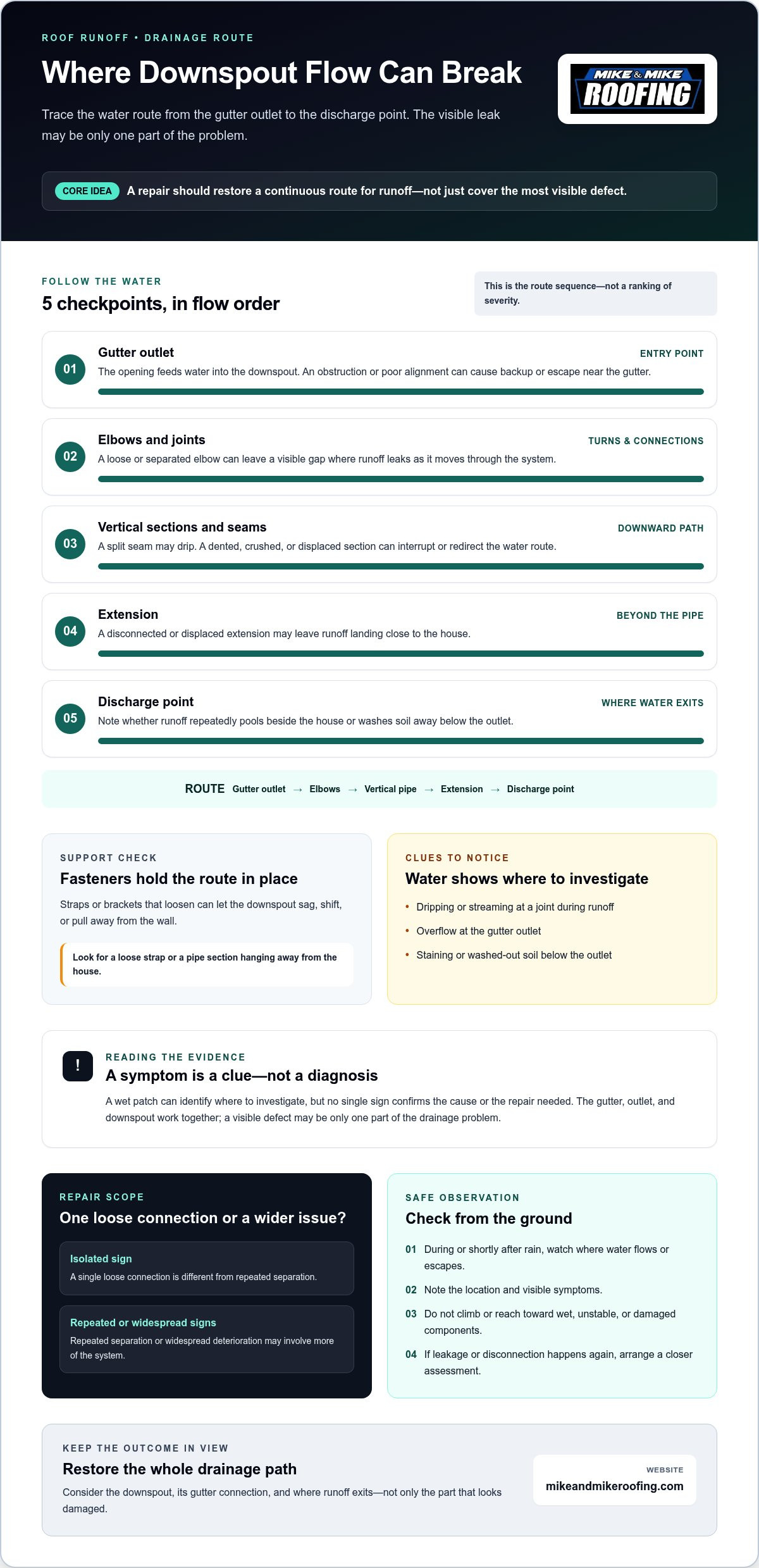
Pay attention to where water appears, not just where the pipe looks damaged. Overflow at the gutter outlet can point to a connection problem or a blockage in the flow path. A wet patch below a joint identifies a spot to investigate. These are clues, not a diagnosis: the gutter, outlet, and downspout work together, so the visible defect may be only one part of the drainage problem.
When should you respond after a storm?
During or shortly after rainfall, observe from a safe location and note whether water flows through the outlet or escapes at a joint. Don’t climb or reach toward wet, unstable, or damaged components. If leakage or disconnection happens again, arrange a closer assessment rather than assuming the first sign was a one-time issue.
For homes in Weatherford, Fort Worth, and Aledo, use the same practical check: notice where runoff exits and whether it repeatedly lands against the house or washes soil away. Record the location and visible symptoms from the ground. This helps distinguish an isolated loose connection from a problem that may involve more of the drainage route.
How a Gutter Downspout Carries Water Away from Your Home
A downspout is one part of a connected drainage route. Rain runs across the roof to the edge and enters the gutter. From there, water moves through the gutter outlet, around one or more elbows, and down the vertical pipe. Joints connect the pieces, fasteners hold the pipe in place, and an extension may carry runoff farther from the wall. The route ends at the discharge point, where water leaves the system.
A downspout repair restores a continuous route for runoff, from the gutter outlet to the place water is discharged. That’s why a visible dent or leak shouldn’t automatically be treated as an isolated pipe problem. If the gutter outlet is blocked, poorly aligned, or no longer joined securely to the downspout, water may spill over the gutter or escape at the connection. A blockage farther down can also slow or stop the flow, leaving water to find another way out.
Which downspout parts commonly fail?
Each part has a job, and its condition can help show where runoff is being interrupted. Use visible symptoms to guide an assessment, rather than deciding which part to replace before the source is clear.
- Gutter outlet: The opening that feeds the downspout may be obstructed or poorly aligned with the pipe, causing water to back up or escape near the gutter.
- Elbows: These turns connect sections around roof edges or walls. A gap or loose elbow can leak or separate as water flows through.
- Vertical sections and seams: A split seam may drip, while a dented or deformed section can interfere with the route.
- Fasteners: Straps or brackets hold the pipe against the exterior. If they loosen, the downspout may sag, shift, or pull away.
- Extensions: A disconnected or displaced extension can leave runoff landing close to the house instead of carrying it farther away.
These components work as a chain. Replacing one part without identifying why water is escaping may leave the underlying flow problem in place.
Why does the discharge point matter?
The system’s job isn’t finished when water exits the vertical pipe. The final outlet should carry runoff away from the immediate area beside the home. If water repeatedly pools there or cuts a channel through soil, note the location and pattern. Those observations show where runoff is landing. They do not prove structural or foundation damage.
For a broader look at upkeep, the gutter maintenance guide for protecting the foundation covers how the larger drainage system fits together. Mike and Mike Roofing provides gutter cleaning services for homeowners in Weatherford, Fort Worth, and Aledo. To discuss gutter service for your home, request a free estimate through the company website.
Downspout Repair or Replacement: How to Judge the Right Scope
A downspout with one loose connection may need a different remedy from a system with several damaged sections. The visible symptom is a starting point, not a repair plan. The right scope depends on what caused the problem, whether nearby parts remain sound, and whether water can move through the full route without escaping or backing up.
Use this comparison to understand what an inspection may need to consider. The visible signs alone can’t confirm the cause or determine the work required.
Isolated loose connection: One joint or attachment has shifted, while surrounding sections appear intact. Check what allowed it to move and whether the connected parts still fit securely.
Localized leak: Water escapes from one seam or small area. The material’s condition and the source of the leak help determine whether a focused repair is suitable.
Repeated separation: Joints come apart again after being reattached, or several connections are loose. The pattern may point to movement, poor fit, or another issue along the connected route.
Widespread deterioration: Multiple sections are crushed, corroded, distorted, or otherwise failing. A broader assessment can show whether repairing individual spots would address the overall condition.
When might a localized repair make sense?
A separated joint or loose attachment may call for a focused remedy if the surrounding downspout and gutter connection remain in sound condition. Appearance alone doesn’t settle it. The repair approach depends on the material, how the pieces fit, and why movement or leakage started. Sealant or a patch isn’t a universal answer: it may not address a poor connection, a damaged section, or a recurring source of movement.
During gutter downspout repair, follow the water path around the affected spot. If the outlet feeding the pipe is damaged or the gutter itself is pulling away, fixing only the downspout could leave the cause untouched. A localized leak can involve a connection beyond the place where water is easiest to see.
What suggests broader damage needs attention?
Several failing joints, crushed sections, recurring separation, or visible damage extending to the gutter outlet call for a closer look at the connected components. Repeated symptoms matter because they can show that the first visible defect is not the whole issue. An on-site assessment helps establish whether the scope is limited to one component or includes more of the drainage route. The cause and extent of damage should be established before a repair plan is set.
For signs involving the gutter system beyond the downspout, the rain gutter replacement guide provides broader context on gutter condition. It isn’t a recommendation to replace your gutters. It can help explain why the outlet and surrounding gutter deserve attention as part of the assessment.
Mike and Mike Roofing serves Weatherford, Fort Worth, and Aledo with gutter cleaning and other exterior services. If you’re looking for gutter service, you can request a free estimate through the company website.
Safe Steps to Check a Gutter Downspout Before Repair
A safe check is about gathering useful clues, not testing the system by hand. You can note where water escapes and whether the problem returns without climbing, pulling on a pipe, or reaching toward a damaged connection. These observations help clarify what an assessment should cover before any gutter downspout repair begins.
- Observe from the ground. Look along the visible downspout for detached sections, dents, loose-looking attachments, or staining. Choose a stable spot away from runoff, and don’t stand beneath a section that appears unstable.
- Note where water escapes. If you observe during rainfall, stay in a sheltered, stable location. Watch for water coming from a joint, spilling near the gutter outlet, or running down the wall. Don’t move closer to get a better view.
- Check the outlet visually. From the ground, look for an obvious obstruction or a gap where the gutter connects to the downspout. Don’t insert tools, pull at the pipe, or try to clear a blockage from an elevated position.
- Document whether it repeats. Record which area leaks, where water collects, and whether the symptom returns after conditions change. A ground-level photo can help show the location, but don’t risk your footing to take one.
What can you check safely from the ground?
Look for visible separation, dents, staining below a joint, or water collecting near the outlet. During rain, observe only from a sheltered, stable position. If you can’t see the outlet clearly from the ground, leave it alone. Note the affected section and whether the same leak or overflow appears again. These details are more useful than guessing at a repair based on one brief observation.
When is professional assessment the safer choice?
Arrange a professional assessment if the suspected damage is elevated, an attachment looks unstable, a blockage persists, or leakage keeps recurring. Don’t climb a ladder to test a joint, detach a section, or apply a patch. A thorough assessment considers the gutter connection, downspout condition, and discharge route together, helping identify whether the visible symptom is part of a broader drainage issue.
Stop your check if water is flowing near electrical equipment, a section appears at risk of falling, or the ground is too slippery to stand safely. You don’t need to touch the system to make a useful report. Share what you observed and where it happened. That gives a professional a clear starting point while keeping you off the ladder and away from unstable components.
Mike and Mike Roofing is a family-owned, father-son exterior contractor serving Weatherford, Fort Worth, and Aledo, with gutter cleaning among its services. If you need gutter service, request a free estimate through the company website.
Gutter Downspout Repair in Weatherford, Fort Worth, and Aledo
A leaking or disconnected downspout can be easy to spot, but the cause may sit at the gutter outlet, along the pipe, or where runoff leaves the system. Mike and Mike Roofing is a family-owned, father-son exterior contractor serving Weatherford, Fort Worth, and Aledo. For homeowners in these communities, a useful assessment considers the connected drainage path, not just the section that appears damaged.
The company has an A+ BBB rating and 5-star customer reviews. These offer context about the business, while each home and drainage concern still requires attention to its own conditions. A clear assessment should explain what the visible symptoms suggest and what needs attention, without assuming a particular repair before the components have been examined.
What should a downspout assessment establish?
A thorough assessment identifies the visible failure point and considers whether nearby gutter components affect water flow. If a joint leaks, for example, its fit and the condition of the connected sections matter. If runoff spills near the gutter, the outlet may also need attention. The goal is to understand how water moves through the route and where it stops behaving as intended.
Before work proceeds, the intended scope should be explained in straightforward terms. That means identifying the affected area and whether the concern appears limited to the downspout or extends to a connected gutter component or discharge route. The right approach depends on the condition found on site. It shouldn’t be assumed from a photo or a single symptom alone.
To make an assessment more focused, note:
- Where you see water escaping or pooling.
- Which downspout section or gutter connection appears affected.
- Whether the symptom has returned after rain.
These observations give the assessment a practical starting point. They don’t replace an inspection, but they can help focus attention on the area that concerns you.
How to take the next step with Mike and Mike Roofing
If you’re in Weatherford, Fort Worth, or Aledo and the same leak, separation, or pooling keeps returning, write down what you’ve observed and where it happens. Note whether it recurs after rain. You don’t need to climb or handle a loose component to provide useful details. Mike and Mike Roofing provides gutter cleaning and other exterior services in the area.
For a straightforward next step, request a free estimate for gutter service.
Take the Next Step Toward Reliable Drainage
You don’t need to decide on a repair before you understand what’s causing the concern. Start by noting where water escapes, whether the issue returns, and which part of the drainage route appears affected. A suitable gutter downspout repair should address the source of the problem, not just make the visible symptom disappear temporarily.
If you’re unsure what the issue means for your home, describe what you’ve noticed and where it occurs. Mike and Mike Roofing is a family-owned, father-son contractor serving Weatherford, Fort Worth, and Aledo, with gutter cleaning among its exterior services. The company’s A+ BBB rating and 5-star customer reviews offer additional context as you consider your next step.
Request a free estimate from Mike and Mike Roofing for gutter service in Weatherford, Fort Worth, or Aledo.
Frequently Asked Questions
Can a gutter downspout be repaired instead of replaced?
Often, yes. Gutter downspout repair may suit a localized issue, while damage across several sections can call for a broader scope. A single connection that has shifted is different from multiple sections that no longer hold their shape. An assessment should identify the source and explain which components are affected before work is recommended. Replacement shouldn’t be assumed simply because water is escaping.
What are the signs that a downspout needs repair?
Common signs include water escaping at a joint, a section pulling away from the wall, a dent, repeated overflow, or soil washing away near the outlet. Note when the symptom appears: a leak during rainfall differs from old staining that remains after the area dries. Observe from the ground and record the location. Don’t climb to inspect a high joint or try to move a loose pipe.
Can a clogged downspout cause water to overflow?
Yes. If a blockage slows or stops runoff, water may back up and spill from the gutter rather than travel through the downspout. But overflow alone doesn’t prove the pipe is clogged. The gutter outlet or a disconnected section could also interrupt flow. If the same overflow happens again, record where it begins and have the connected parts assessed before attempting to clear a hard-to-reach obstruction.
How do I know whether a downspout is draining away from my house?
From a sheltered, stable spot, observe where water lands as it leaves the outlet. If it repeatedly runs beside the wall, collects in the same low area, or carries soil away, the discharge route may need attention. Look at the ground after the flow stops and note where dampness remains. These clues show where runoff is going, but they can’t establish whether the foundation has been damaged.
Is it safe to repair a gutter downspout from a ladder?
Climbing to repair a downspout can be hazardous, particularly near roof edges or if the gutter attachment is loose or wet. For a basic check, observe from the ground and write down what you can see. Don’t climb to test a joint, detach a section, clear a persistent blockage, or apply sealant. If the damaged area is elevated or unstable, leave the inspection and repair to a professional.
Who should I contact for gutter downspout repair in Weatherford, Fort Worth, or Aledo?
Mike and Mike Roofing serves homeowners in Weatherford, Fort Worth, and Aledo and provides gutter cleaning services. If you have a downspout concern, note where the symptom appears, what you observed, and whether it has happened more than once. You can request a free estimate through the company website for gutter service.


