

A “0% interest” offer can look like the easiest way to replace a roof, but the payoff deadline and terms matter as much as the headline. If you’re considering financing a new roof Fort Worth homeowners can compare several payment routes. Start by confirming the project scope and deciding what repayment could realistically fit your budget.
A roof replacement can strain household cash flow, especially when storm damage raises questions about insurance coverage, deductibles, and out-of-pocket costs. It’s reasonable to want a clear picture before signing anything. An insurance claim may help with covered damage, but coverage depends on your policy and the details of the loss.
This guide explains common payment routes, including personal loans, home equity options, and promotional financing, as well as the terms that affect total cost. You’ll learn what project details and documents to gather, how to compare repayment plans, and why a clear, project-specific estimate is a useful starting point. Mike and Mike Roofing is a family-owned roofing contractor based in the Weatherford area, serving Fort Worth and Aledo. A written roof estimate can help you understand the work before you weigh payment choices.
Key Takeaways
- Start with a documented roof scope so you can compare payment options against the actual project, not a rough guess.
- Understand how personal loans, home equity options, and promotional offers differ. Approval and terms depend on the lender and applicant.
- When comparing financing a new roof Fort Worth offers, look beyond the advertised payment to APR, fees, repayment term, promotional deadlines, and total repayment.
- For storm damage, organize policy documents and arrange a professional roof assessment. Coverage depends on the policy, cause of damage, exclusions, and claim decision.
- Use a written estimate to weigh the roof scope, materials, workmanship, and warranty information before deciding when and how to proceed.
Financing a New Roof in Fort Worth: Start With the Need and the Project Scope
A roof decision can arrive before the household budget is ready. An aging roof may be nearing replacement, or a leak or visible storm damage may call for a timely assessment. Financing can spread a documented project cost over time, subject to the lender’s approval and terms. It’s a way to pay, not proof that replacement is necessary.
First, find out what the roof needs. A useful project scope describes the work and materials, separates necessary work from optional upgrades, and gives you an estimate to use when comparing payment choices. For example, required repair or replacement work belongs in the core scope, while a material upgrade can be listed separately. This distinction helps you avoid treating an optional addition as a necessary cost.
Roofing is one type of home project, alongside other work that can improve or maintain a property. The Home Improvement Overview provides broader context, but a roof financing decision should be based on your roof’s condition, written scope, and household priorities.
How to tell whether financing belongs in the decision
Weigh the roof’s condition against available cash and near-term obligations, such as essential bills or planned expenses. If the roof has active damage, delaying an assessment or necessary work can allow water intrusion or related property concerns to develop. Further damage is not certain, but the possibility is a reason to get clear information rather than rely on guesswork.
Before comparing payment arrangements, obtain a written scope and estimate. The estimate gives you a project amount to evaluate, while the assessment helps separate work that needs attention from improvements you may choose to make later.
Fort Worth roof projects: planned replacement or storm concern?
Planning for an aging roof differs from responding to a roof concern after hail or severe weather, both relevant to North Texas homeowners. An aging roof may call for a condition assessment and time to plan. If you suspect storm damage, review your insurance policy and document visible concerns safely. Don’t assume the damage qualifies for coverage or that insurance will pay the full project cost.
For financing a new roof Fort Worth homeowners can make a more informed decision by establishing the need and scope first. A professional roof assessment and clear estimate show what work is proposed; policy terms and the insurer’s decision determine whether a claim applies. With those questions separated, you can evaluate the project and payment plan on their own merits.
Roof Financing Options: Understand the Main Ways to Pay
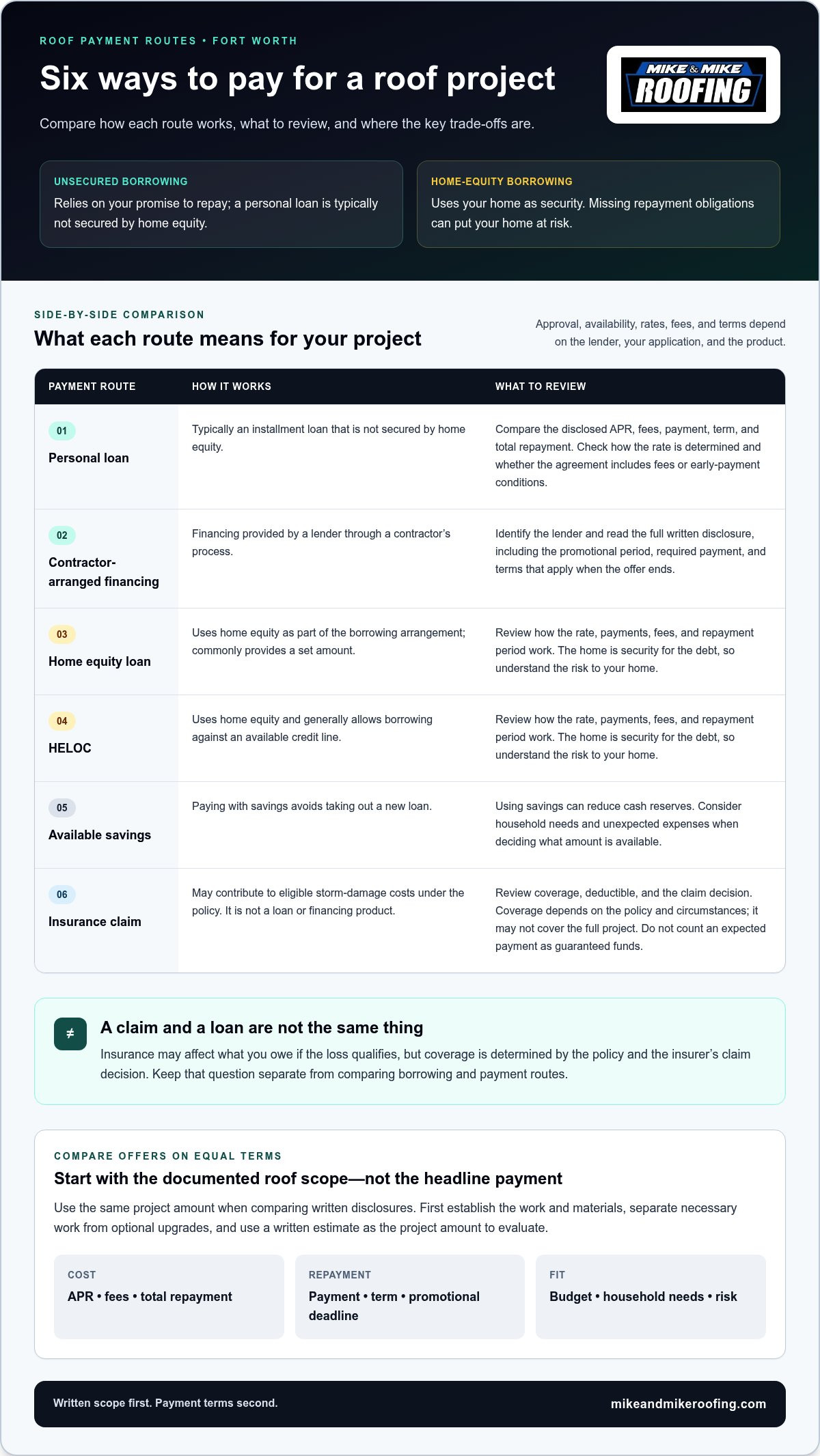
Once the roof scope is clear, compare how each payment route works, what it may put at risk, and how repayment fits your budget. Approval, availability, rates, fees, and terms depend on the lender, your application, and the product. A financing offer isn’t automatically a good fit just because it lowers the first payment.
Keep insurance separate from borrowing. An insurance claim is not a loan, and coverage applies only if the policy and circumstances of the loss qualify. A claim decision may affect what you owe, but don’t count an expected insurance payment as guaranteed funds when weighing payment options.
Unsecured borrowing relies on your promise to repay; home-equity borrowing uses your home as security for the debt. This distinction matters. With secured borrowing, failing to meet repayment obligations can put your home at risk.
Personal loan: This is typically an installment loan that isn’t secured by home equity. Compare the disclosed APR, fees, payment, term, and total repayment. Check how the rate is determined and whether the agreement includes fees or early-payment conditions.
Contractor-arranged financing: This is financing provided by a lender through a contractor’s process. Read the full written disclosure, including any promotional period, required payment, and terms that apply when the offer ends.
Home equity loan or HELOC: These use home equity as part of the borrowing arrangement. A home equity loan commonly provides a set amount, while a HELOC generally allows borrowing against an available credit line. Review how the rate, payments, fees, and repayment period work, and understand the risk to your home.
Available savings: Paying with savings avoids taking out a new loan, but it can reduce cash reserves. Decide what amount you can use while keeping funds for household needs and unexpected expenses.
Insurance claim: A claim may contribute to eligible storm-damage costs under the policy. Review your coverage, deductible, and claim decision. Insurance is not a financing product and may not cover the full project.
Contractor-arranged financing and personal loans
These routes can spread a project cost into payments, but the advertised headline doesn’t show the full cost. For contractor-arranged plans, identify the lender and read the agreement’s complete terms. For a personal loan, review eligibility requirements, APR, fees, payment amount, and repayment period. Compare written disclosures using the same project amount so you’re weighing like against like.
Home equity borrowing and available cash
Home equity loans and HELOCs have a different structure from unsecured personal loans, but the home secures the debt. Consider that risk alongside the payment and rate. Using savings avoids borrowing costs, yet drawing down too much can leave little room for other needs. Balance repayment obligations against the cash reserve your household needs.
For financing a new roof Fort Worth homeowners should compare the full obligation, not just the initial payment. A project-specific roof installation estimate gives you a grounded amount to evaluate before deciding how to pay. Mike and Mike Roofing provides roof estimates for projects in the Fort Worth area, helping homeowners understand the proposed scope before comparing financing terms. Review roof estimate options as a practical step in that comparison.
Compare Roof Financing Offers by Total Repayment, Not the Headline
A low advertised payment can make an offer look manageable while hiding a longer term, fees, or a costly change after a promotion ends. The lowest initial payment isn’t necessarily the lowest total borrowing cost. Compare written terms side by side, using the same project amount and repayment assumptions for each offer.
Use this checklist for every lender disclosure or financing agreement:
- APR: Record the annual percentage rate and whether it can change. APR helps show borrowing costs, including certain fees, but read the disclosure to understand what it includes.
- Fees: Note any origination, late-payment, prepayment, or other charges stated in the agreement.
- Term: Compare how long repayment lasts and how many payments are scheduled.
- Required payment: Check the amount due, when payments begin, and whether the payment may change.
- Promotional end date: Mark the deadline and identify the rate or payment structure that applies afterward.
- Total repayment: Review the full payment schedule to see the expected amount paid over the life of the borrowing, including applicable fees or interest.
Read the full disclosure before accepting an offer
Promotional language is only part of the offer. Find out whether a reduced or deferred rate has conditions, what happens when the promotion ends, and whether the remaining balance moves to a different rate or payment schedule. Deferred interest may apply under certain agreements if the balance isn’t paid by a specified date. Don’t assume it applies to every promotion. Read the contract language to learn how interest is calculated and what triggers it.
Check the agreement for fees, due dates, late-payment consequences, and terms for paying early. Compare the required schedule with dependable household cash flow, not an optimistic plan that depends on future income or cutting essential expenses. If the expected payment only works under ideal conditions, the offer may be a poor fit.
Use the same project assumptions in every comparison
Base each comparison on the same written roof scope and project amount. If one offer includes optional upgrades and another covers only necessary work, their payment figures aren’t directly comparable. Separate core roof work from additions, then compare the borrowing terms for the same amount and planned repayment period.
For financing a new roof Fort Worth homeowners should use current lender disclosures rather than generic rates or sample payment amounts. Terms vary by applicant, lender, and product, so an online estimate may not reflect the final offer. Note any assumptions behind a quoted total, including whether it depends on paying off a promotional balance by a deadline or making every payment as scheduled.
Before deciding, write down the expected total repayment and the conditions that could change it. This makes the trade-offs clear: payment size, repayment length, fees, and the possibility of higher costs if the terms aren’t met. It’s a more reliable basis for choosing than a headline alone.
Fort Worth Homeowners: Make a Plan for Storm Damage, Insurance, and Payment
After hail or severe weather, it can be hard to tell whether a roof needs replacement, repair, or a closer look. Keep the insurance decision separate from the payment decision. A storm concern doesn’t establish that a claim will be covered, and an insurance claim doesn’t guarantee the insurer will pay for the full project.
Use this sequence to gather information without taking unnecessary risks:
- Document what you can see safely. Note the date of the storm and visible signs, such as displaced shingles or water marks indoors. Take photos from the ground or another safe location. Don’t climb onto the roof to inspect or photograph it.
- Organize your records. Keep photos, dates, prior inspection or repair records, and messages about the damage together. This gives you a straightforward timeline to refer to when discussing the issue.
- Review your policy. Look for roof coverage details, deductibles, exclusions, and claim instructions. Contact your insurer directly about coverage and required documentation.
- Arrange a professional roof assessment. A written assessment and scope can clarify the work being considered. Use it as project information to compare with the insurer’s decision and any proposed payment plan.
If a storm may have damaged the roof
Stick to observable facts. A photo of a ceiling stain, for example, records what you can see, but it doesn’t establish the cause or whether the policy covers it. Avoid guessing about when damage occurred or describing work that isn’t in the assessment. Keep copies of insurer correspondence and note the dates of calls or submitted documents to maintain an organized record.
Keep the insurance decision separate from the payment decision
Coverage depends on the policy language, cause of damage, exclusions, and the insurer’s claim decision. If a claim is approved, the payment may still not cover every part of the project. Where applicable, the policy deductible and costs for work the insurer doesn’t cover remain the homeowner’s responsibility. Review the insurer’s written decision and ask the insurer about any coverage or claim requirement you don’t understand.
Use the roof assessment to understand the proposed work, not to predict the claim outcome. If the insurer’s scope and the contractor’s documented scope differ, keep both documents and discuss the discrepancy with the insurer before assuming what will be paid. Don’t commit to a payment plan based on an expected claim amount until you understand the decision and your potential out-of-pocket share.
This separation can help Fort Worth homeowners approach financing a new roof with a clearer view of the project and any insurance contribution. Once you have a written roof scope, you can evaluate the remaining obligation without treating a possible claim payment as certain. Mike and Mike Roofing provides roof assessments and estimates for local projects. See the roof estimate process.
Plan Your Fort Worth Roof Project With a Clear Estimate and Next Steps
A steady plan makes it easier to evaluate the roof work and payment choice separately. Establish the need, get the scope in writing, compare actual repayment terms, and schedule when the project and budget make sense. Financing should support a defined roof project, not drive decisions about work your home may not need.
- Define the need. Clarify whether the roof needs replacement and identify work that should be included. Keep optional upgrades separate from necessary work.
- Obtain a written estimate. Use a project-specific scope to understand the proposed installation, materials, and work involved.
- Compare payment terms. Match each offer to the same project amount, then weigh the APR, fees, term, required payment, and total repayment.
- Schedule deliberately. Move ahead when the roof scope, payment plan, and timing are clear enough for your household to make a considered decision.
What a project-specific estimate helps you plan
An estimate connects the proposed work for your home with the materials and installation needed to complete it. Ask for the scope to distinguish required replacement work from optional items, so the amount you compare with financing terms reflects the project you intend to undertake. Materials, workmanship, and warranty information also matter: they help you evaluate the roof beyond the first payment. For more on what goes into the work, see A Comprehensive Guide to Residential Roof Installation in Weatherford & Fort Worth (2026).
Mike and Mike Roofing is a family-owned, father-son roofing contractor based in the Weatherford area and serving Fort Worth and Aledo. The team installs roofs using premium Owens Corning materials. Its A+ BBB rating and 5-star reviews offer additional context as you consider the work. The company provides free estimates and industry-leading work warranties. Review the warranty information for your project and its stated terms.
Take the next step without pressure
A free estimate can help you understand the proposed roof work before choosing how to pay. Use the written scope in your financing comparison, and check that each option covers the same work. If you’re considering financing a new roof Fort Worth, understand both the roof project and repayment obligation before setting a schedule. A clear estimate is a practical starting point, not a commitment to a payment plan.
View free roof estimate information to get a clearer picture of your project and plan your next step.
Make Your Next Roof Decision With Confidence
Set a clear decision point before committing: choose the project scope you’re prepared to move forward with, then make sure the payment schedule fits your household’s real budget, not just an ideal month. Keep the estimate and financing agreement together so you can refer to the same project details throughout the decision. If storm damage is involved, understand the insurer’s position before treating a potential payment as part of your budget.
This measured approach can make financing a new roof Fort Worth homeowners need feel more manageable. You don’t have to settle every question at once. Start with a clear picture of the roof work, then decide what repayment terms feel sustainable for your household.
Start with a clear project scope. Request a free roof estimate from Mike and Mike Roofing to understand the proposed work and plan your next step.
Frequently Asked Questions
Can I finance a new roof if I have bad credit?
Possibly, but approval and terms depend on the lender’s criteria and your application. A lender may consider factors such as income, existing debt, credit history, and the requested amount. A lower credit score can affect eligibility or the offered rate, so don’t assume an advertised offer will apply to you. Before applying, review your budget and compare written offers, including fees and total repayment, if you receive more than one.
Does homeowners insurance pay for a new roof in Texas?
It may pay for eligible roof damage, but coverage depends on your policy, the cause of damage, exclusions, deductible, and the insurer’s claim decision. An aging roof or a storm event alone doesn’t establish coverage. Check whether your policy uses replacement-cost or actual-cash-value terms for the roof, since those approaches can affect the claim payment. Homeowners in Weatherford, Fort Worth, and Aledo should rely on their own policy documents and the insurer’s written decision.
Can I use a home equity loan to pay for a roof replacement?
Yes, if a lender approves your application and the loan terms fit your needs. A home equity loan uses your home as security, so missed repayment obligations can put the property at risk. Before borrowing, review the interest rate, fees, payment schedule, and any costs tied to setting up the loan. Consider how the new payment fits alongside your existing mortgage and other household obligations.
What happens if I miss a payment on roof financing?
The result depends on the agreement, but a missed payment may lead to a late fee, additional interest, or negative credit reporting. Continued nonpayment can have more serious consequences, especially if the borrowing is secured against your home. Check the contract for due dates, grace periods, late-payment terms, and default provisions. If you expect trouble making a payment, contact the lender promptly to understand your options rather than waiting for the account to fall further behind.
Can I pay off roof financing early without a penalty?
It depends on the agreement. Some financing terms may allow early payoff without a penalty, while others may include conditions or fees. Look for a prepayment clause and request a current payoff amount from the lender before sending extra funds. If the offer includes a promotional period or deferred interest, confirm how an early payoff affects that balance and get the lender’s instructions in writing.
Should I finance roof repairs or replace the whole roof?
Base the choice on the roof’s condition and a documented assessment, not on which option is easier to finance. If damage is limited and the rest of the roof remains serviceable, a repair may address the problem. If concerns are widespread, an assessment may indicate that replacement is the more appropriate scope. Ask for the recommended work and any alternatives in writing, then compare the cost and expected obligations for each defined option.
Can I finance a roof replacement while an insurance claim is still pending?
You may be able to apply for financing, but approval and terms remain subject to the lender, and a pending claim doesn’t guarantee an insurance payment. Avoid treating a possible insurance payout as money available for repayment until you receive the insurer’s decision. Compare financing against the amount you could owe without that payment, and understand how any later claim proceeds would affect your loan obligations before committing.


