

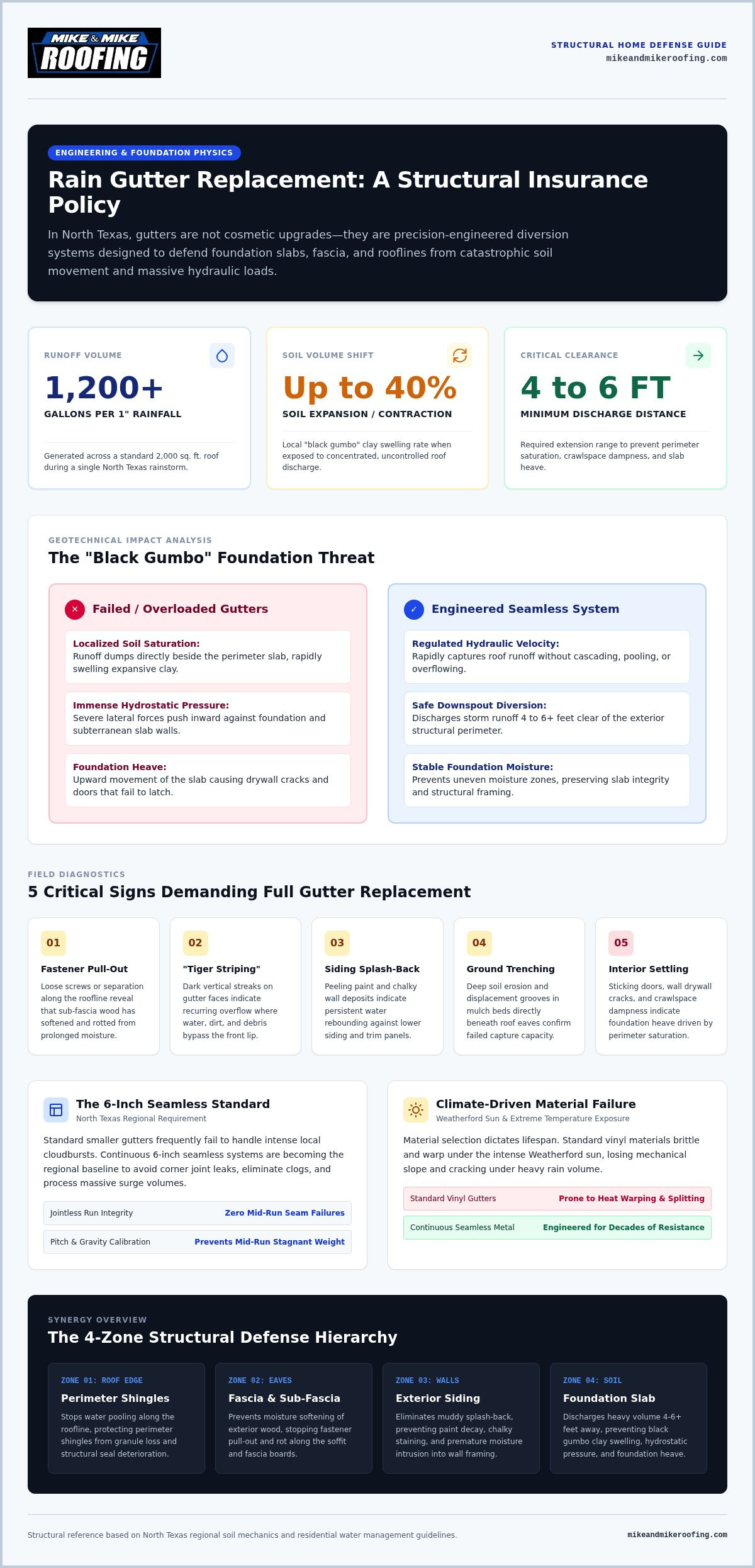
Most homeowners see new gutters as a simple cosmetic upgrade; however, in North Texas, they're actually a structural insurance policy for your foundation. When our local "black gumbo" clay expands and contracts by up to 40 percent between seasons, uneven moisture is your home's worst enemy. If your current system is failing, a professional rain gutter replacement is the only way to stop water from undermining your slab and rotting your roof's fascia boards.
It's natural to feel frustrated by recurring clogs or the sight of water cascading over your roofline during a summer downpour. You want a solution that lasts decades, not just a few seasons. This guide will walk you through the mandatory signs of gutter failure, the most durable materials for the intense Texas climate, and the exact steps of the replacement process. We'll give you the straight facts on why 6-inch seamless systems are becoming the local standard and how to choose a contractor who values craftsmanship over speed. By the end, you'll have the confidence to choose a system that keeps your home dry and your foundation stable for the long haul.
Key Takeaways
- Spot the critical signs of system failure, from visible fastener pull-out to hidden foundation settling around your slab.
- Compare the durability of different materials to see why standard vinyl often fails under the harsh Weatherford sun.
- Understand the technical requirements for a successful rain gutter replacement, including the exact slope needed for efficient gravity-fed drainage.
- Protect your home’s structural integrity by learning how a precision-engineered system safeguards your soffit, fascia, and perimeter soil.
- Identify the specific qualities to look for in a local specialist to ensure your exterior protection is built for long-term security.
Beyond the Leak: Identifying Critical Signs for Rain Gutter Replacement
A leaking corner or a noticeable drip during a storm is an obvious nuisance, but the most dangerous signs of gutter failure are often the ones you have to look for. Many homeowners delay a rain gutter replacement because the system still looks mostly intact from the curb. However, gutters don't just carry water; they manage the structural weight of heavy rainfall. When fasteners begin to pull away from the fascia board, it isn't just a loose screw. It's usually a sign that the wood behind the gutter has softened from rot or that the system is too heavy for its current hardware.
If you find yourself cleaning your system every month only to see it overflow during the next storm, you're likely dealing with a pitch or capacity problem rather than just debris. Over time, houses settle and fascia boards can warp. This changes the "slope" of your run, causing water to pool in the middle rather than flowing toward the downspouts. While there are several types of rain gutters available for residential use, any system that allows stagnant water to sit will eventually fail due to weight and corrosion.
Visual Red Flags on the Fascia and Siding
Take a walk around your home's perimeter on a dry day. Look for "tiger striping," which are dark, vertical streaks on the exterior of the gutter. These indicate that water is consistently overflowing the front lip, carrying dirt and pollutants that stain the finish. Check the siding for peeling paint or chalky stains; these are signs that water is splashing back against the house. You should also examine the ground directly below the roofline. If you see soil erosion or "trenching" in your mulch beds, your gutters are no longer capturing the runoff. This concentrated water eventually rots the wood sub-fascia, making a full rain gutter replacement mandatory to restore the home's seal.
The Hidden Impact on Your Foundation
The most expensive damage happens where you can't see it. When water isn't moved at least 4 to 6 feet away from your home, it saturates the perimeter soil. In North Texas, our "black gumbo" clay can expand in volume by up to 40 percent when wet. This creates immense hydrostatic pressure against your foundation walls, often leading to interior drywall cracks or doors that suddenly won't latch. Foundation heave is the upward movement of a home's slab caused by the swelling of expansive clay soils as they absorb excessive, concentrated moisture. If you notice dampness in your crawlspace or basement, your gutters are likely the primary culprit.
The Structural Physics of Water Management: Why Gutters Matter
A gutter system is far more than a simple metal channel attached to your roofline. It's a precision-engineered diversion tactic designed to manage the massive hydraulic load your home faces during a storm. Without this system, water falls from the roof with enough force to erode landscaping and splash mud against your siding. This "splash-back" effect doesn't just look bad; it introduces constant moisture to your lower-level siding, leading to premature rot and paint failure. A timely rain gutter replacement ensures this cycle is broken before structural damage takes hold.
Functional gutters also play a vital role in extending the lifespan of your roof's perimeter shingles. When water isn't cleared quickly, it can pool at the edge of the roofline, leading to granule loss and shingle deterioration. By maintaining a clear path for runoff, you protect the most vulnerable parts of your roof's exterior seal.
Diverting Thousands of Gallons of Runoff
The sheer volume of water involved in a standard North Texas storm is often underestimated. According to research on roof runoff and foundation moisture, a single inch of rainfall on a 2,000-square-foot roof yields over 1,200 gallons of water. If your system is failing, that volume isn't being diverted; it's being dumped directly onto your home's perimeter. Proper downspout placement is critical to ensuring this water doesn't pool in your yard or saturate the soil near the slab. While the hardware must be sturdy, regular professional gutter cleaning remains a prerequisite for maintaining the velocity needed to move this volume safely away from your property.
Synergy Between Gutters and Roofing
Gutters and roofing must work in total harmony to protect the home's skeleton. The drip edge flashing at the roof's perimeter is designed to bridge the gap between the shingles and the gutter trough. If these components aren't aligned, water can wick back into the fascia and soffit, rotting the very boards that support your roof. Even in our warmer climate, proper drainage prevents the localized "ice damming" that can occur during rare winter freezes, where standing water expands and lifts perimeter shingles. For a full understanding of how these layers interact, consult our comprehensive guide to residential roof installation. Ensuring these systems are integrated correctly is the best way to safeguard your investment. If you're unsure about your current system's performance, you can always request a free estimate for a professional assessment.
Evaluating Gutter Materials and Styles for North Texas Climates
Choosing the right material is the most critical decision in a rain gutter replacement. In North Texas, your system must withstand intense UV radiation, sudden temperature swings, and heavy hail. While vinyl gutters are often marketed as a cost-effective DIY option, they rarely survive the Weatherford heat. The plastic becomes brittle and warps under the summer sun, leading to cracks and failed hangers within just a few seasons. Aluminum and steel offer the structural rigidity needed to handle our specific storm cycles without the risk of UV degradation.
Capacity is just as important as material choice. Standard 5-inch gutters often overflow during torrential North Texas downpours, leading to the foundation issues discussed earlier. Moving to a 6-inch system increases water management capacity by approximately 40 percent, which is often the difference between a dry crawlspace and a flooded one. Modern 2026 coatings have also evolved significantly. High-performance polymer finishes now provide superior scratch resistance and color-match technology that stays vibrant despite constant sun exposure.
The Seamless Advantage
Sectional gutters rely on seams held together by sealants and connectors. These seams are the primary failure point in residential systems because they expand and contract at different rates than the metal, eventually breaking the seal. On-site fabrication solves this by using a portable roll-forming machine to extrude a single, continuous piece of metal tailored to your exact roofline. This custom fit eliminates the weak points found in store-bought kits and provides a cleaner, more professional appearance that lasts much longer.
Material Durability and Hail Resistance
Heavy-gauge .032 aluminum is the industry standard for residential protection because it's lightweight and naturally rust-resistant. It maintains its shape after impact better than thin-gauge alternatives often found in retail stores. For those seeking a legacy solution, copper offers a 50-year lifespan and develops a protective patina that shields the metal from the elements. Aluminum expands and contracts at a rate approximately twice that of steel, which is why professional installers must use specific hanger spacing to account for thermal movement. Maintaining proper gutter and downspout drainage is only possible if the material itself can withstand the physical stress of our local environment.
The Precision of Professional Installation: A Step-by-Step Overview
A successful rain gutter replacement relies on precise geometry rather than just aesthetics. Many homeowners assume that if a gutter looks straight, it's working correctly. This is a common misconception. A gutter that looks perfectly level is actually a liability. Without a calculated pitch, water will stagnate in the trough, leading to mosquito breeding, heavy debris accumulation, and eventual corrosion. We ensure every run is pitched with a continuous downward slope toward the collection outlets to maintain self-cleaning velocity.
Before any new hardware is attached, we perform a blunt assessment of the fascia boards. If the wood is soft or degraded, it cannot provide the structural anchor needed for a long-term installation. Securing the fascia is a mandatory step; we ensure every hidden hanger is screwed through the board and into the structural rafter tails. Once the system is mounted, we conduct a final water flow verification. This testing phase involves running water through the high points of the system to confirm that every drop reaches the downspout without pooling or leaking behind the metal.
Pitch and Alignment Calculations
Residential construction standards require a downward slope of no less than 1/4-inch for every 10 linear feet. If this pitch is off by even a fraction, the system's capacity is compromised. Hanger spacing is equally vital for stability. While 24 inches is the standard maximum interval, we often reduce this to 18 inches in areas exposed to severe wind or heavy storm loads. This extra reinforcement prevents the system from sagging or pulling away from the house during the intense weather cycles common in Weatherford. Finally, we ensure downspouts are angled to discharge water at least 5 to 10 feet away from the foundation to prevent back-saturation of the perimeter soils.
Integration with Gutter Protection
During the replacement process, it's the ideal time to determine if your home is a candidate for gutter guard installation. While guards can significantly reduce the frequency of manual cleanings, they also change the weight load on your fascia board. A precision-installed system accounts for this added weight from the start. We're always honest with our neighbors: even with the best guards, no system is entirely maintenance-free in heavily wooded areas. However, the right protection can prevent the clogs that lead to overflow and foundation damage. Requesting a free estimate is the most reliable way to get a straight-shooter assessment of which system fits your home’s specific needs.
Securing Your Home with a Trusted Local Gutter Specialist
Weatherford and Fort Worth homeowners face unique environmental challenges that national contractors often overlook. Between the extreme heat that warps inferior materials and the sudden, torrential storm cycles, your exterior drainage system needs to be built for North Texas specifically. A standard rain gutter replacement is only as good as the installer's understanding of local drainage needs. Choosing a specialist who lives and works in your community ensures that your system is designed to handle the specific rainfall intensity and soil conditions of our region.
When you work with a family-owned, father-son operation like Mike and Mike Roofing, you're getting a level of personal accountability that larger corporations can't match. We don't rely on high-pressure sales or "marketing fluff." Instead, we provide a blunt, honest assessment of your home's needs. This "straight-shooter" approach is backed by an A+ BBB rating and a legacy of hands-on involvement in every project. We treat your property with the same protective instinct we'd apply to our own homes.
It's also vital to understand the difference between material and workmanship warranties. While many manufacturers provide long-term coverage for the metal finish, those warranties don't cover a sagging gutter or a failed pitch. Our focus is on the precision of the install, ensuring the hardware remains secure through every season. For long-term peace of mind, we recommend integrating your new system with expert gutter maintenance to catch minor issues before they threaten your foundation.
The Mike and Mike Difference
Our team brings a comprehensive perspective to every job because we understand the synergy between your roof and your gutters. We use only premium materials, such as heavy-gauge aluminum, that are proven to survive the Texas sun without becoming brittle. Because we're also experts in roof and siding installation, we ensure that your new gutters integrate perfectly with your drip edge and fascia. This holistic approach prevents the common "gaps" in protection that lead to wood rot and water intrusion.
Next Steps for Your Home
Preparing for an estimate is straightforward. Before we arrive, take note of any areas where you've seen water cascading over the roofline or pooling near the slab. During your consultation, feel free to ask about hanger spacing, downspout sizing, and how we'll secure any rotted fascia boards we find. We're here to provide the answers you need to make an informed decision about your home's structural health. Request your free estimate from Mike and Mike Roofing today to get started with a team that values durability and honest craftsmanship.
Protecting Your Home’s Long-Term Stability
Guarding your property against the volatile North Texas climate requires more than just a quick fix; it demands a system designed for precision and durability. A professional rain gutter replacement isn't a cosmetic choice. It's a strategic move to safeguard your foundation against expansive clay soil and prevent roof-edge rot. By prioritizing high-capacity seamless aluminum and ensuring a calculated pitch, you're effectively equalizing moisture distribution around your slab.
As a family-owned and operated father-son team based in Weatherford, we take pride in doing things the right way. We're A+ BBB Rated, 5-star reviewed, and Owens Corning Roofing Specialists who understand how every layer of your home's exterior must work together. We don't believe in high-pressure sales, just honest, expert assessments that help you make the right choice for your property's future.
When you're ready to secure your home's structural integrity, we're here to help. Get a straightforward, honest gutter estimate from Mike and Mike Roofing today. Let's make sure your home stays dry and stable for decades to come.
Frequently Asked Questions
How much does rain gutter replacement typically cost in 2026?
The total investment for a rain gutter replacement depends on your home's linear footage, the number of stories, and the material you choose. Custom seamless aluminum is the residential standard in Fort Worth, but premium options like copper will increase the project scope. We recommend a professional on-site assessment to evaluate your fascia's condition, as rotted wood replacement can also impact the final cost. Every home in Weatherford has unique drainage needs that affect the estimate.
Can I replace just one section of my gutters or do I need a full system?
While you can technically replace a single damaged run, we generally advise against it for long-term reliability. Older sections often have different profiles or faded colors that won't match a new installation. More importantly, the connection points between old and new segments are prone to leaking. A full system replacement ensures that the pitch and drainage capacity are consistent across your entire roofline, providing the stability your foundation needs during heavy North Texas rain cycles.
What is the best gutter material for the North Texas heat?
Heavy-gauge seamless aluminum is the most reliable choice for the Weatherford and Aledo climate. Unlike vinyl, which often warps or becomes brittle under the intense 100-degree Texas sun, aluminum maintains its structural integrity through extreme temperature shifts. It's naturally rust-resistant and lightweight, making it ideal for the sudden, heavy downpours we experience during storm season. We typically use .032 gauge aluminum for maximum durability against wind and debris.
How long does a professional gutter replacement take to complete?
Most residential gutter installations in the Fort Worth area are completed within a single day. A standard-sized home typically takes between four to six hours from the time we arrive with our on-site extrusion machine to the final cleanup. Complex rooflines or homes requiring extensive fascia board repairs may extend the timeline slightly. We focus on a methodical pace to ensure every hidden hanger is secured into a structural rafter tail for maximum stability.
Do seamless gutters really prevent leaks better than sectional ones?
Seamless gutters are significantly more effective at preventing leaks because they eliminate the joints found every ten feet in sectional kits. Every seam in a gutter system is a potential failure point where sealant can dry out and crack over time. By extruding a continuous piece of metal specifically for your home's dimensions, we remove the weak spots that lead to dripping and wood rot. This on-site fabrication ensures a custom, zero-leak fit for your roofline.
Will new gutters help prevent my foundation from cracking?
Yes, a properly installed rain gutter replacement is one of the most effective ways to prevent foundation cracking in North Texas. Our local black gumbo soil expands and contracts based on moisture levels. By diverting roof runoff at least five to ten feet away from your slab, gutters prevent the uneven soil saturation that causes foundations to heave, settle, and eventually crack. This protection is vital for maintaining the long-term structural integrity of your home.
Is it better to install gutter guards at the same time as replacement?
Installing guards during your initial replacement is highly efficient because it allows us to integrate the protection into the system's weight calculations from the start. While no guard is entirely maintenance-free, they significantly reduce the buildup of leaves and debris that cause clogs. This is especially beneficial for homes in wooded areas of Aledo or Weatherford where overhead trees can quickly overwhelm an open trough. A combined installation ensures your new system remains clear and functional.
How do I know if my gutters were damaged by a recent hail storm?
Hail damage isn't always obvious from the ground. Look for small circular dents in the metal, chipped paint, or tiger striping that suggests water is overflowing due to hidden blockages. If your gutters are sagging or pulling away from the house after a storm, the weight of the water may have compromised the hangers. We provide straightforward assessments to help you determine if a repair or full system replacement is necessary for your property.


