

If you’re waiting for a gutter guard that lets you burn your ladder and never look at your roofline again, you’ve been sold a bill of goods. The "maintenance-free" promise is the biggest marketing myth in the home improvement industry today. We’ve seen too many North Texas homeowners invest in a gutter guard installation that eventually fails because they were promised a miracle instead of a tool. It’s time to talk about what these systems actually do for your home’s exterior protection.
You’re right to be skeptical of the glossy brochures and big-box store claims. You want your downspouts clear and your foundation protected from water damage, but you don’t want a sales pitch that ignores reality. This guide provides the straight-shooting truth about protecting your home in 2026. We’ll break down which materials actually handle our local debris, from stubborn oak tassels to heavy spring rains, and why a high-performance filter is better than a "permanent" shield. You’ll learn how to choose a system that offers real security and how to keep your drainage system functioning properly for the long haul.
Key Takeaways
- Understand why "maintenance-free" is a marketing myth and how viewing guards as a filtration system ensures long-term drainage success.
- Identify the best guard types for North Texas to handle specific local debris like live oak tassels and cedar needles.
- Learn how a professional gutter guard installation protects your home from foundation issues and prevents water from rotting your fascia boards.
- Avoid common misconceptions about roof leaks and ice dams that often scare homeowners away from effective protection.
- Discover the essential steps of cleaning, sealing, and re-pitching that must happen before any shield is installed.
The Reality of Gutter Guard Installation: More Than a 'Set It and Forget It' Solution
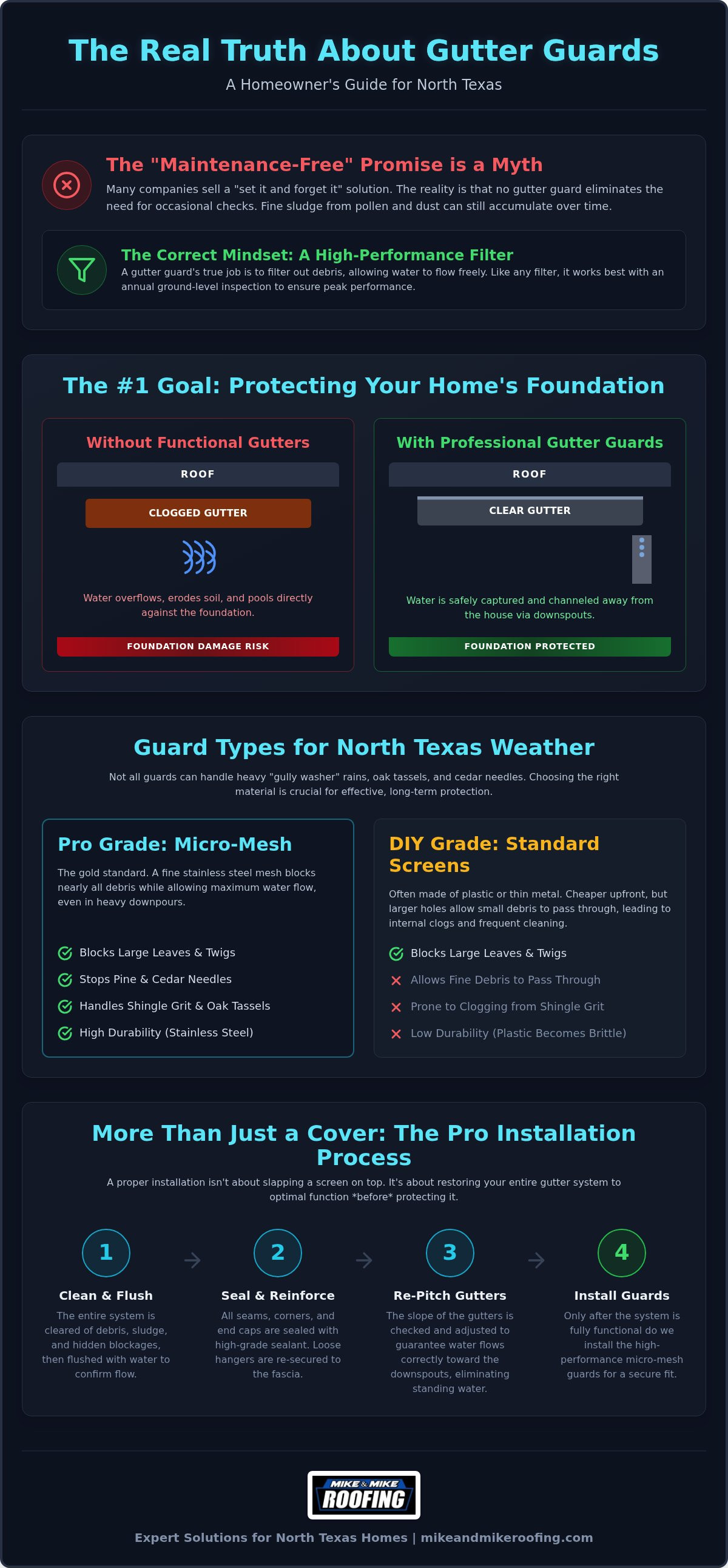
Many homeowners approach gutter guard installation with the hope of never touching a ladder again. Large retailers often fuel this by promising a "permanent" fix. We prefer a more honest approach. A gutter guard is not a magic barrier that makes leaves vanish into thin air. Instead, think of it as a high-performance filtration system for your home’s drainage. Its job is to keep the big stuff out so water can flow freely, but like any filter, it requires a little attention to stay effective.
We've been in the Weatherford area long enough to know that honesty saves our neighbors money in the long run. Telling you that you'll never have to look at your gutters again might get us a quick sale, but it won't protect your home. Transparency about maintenance builds better homes and stronger relationships. We want you to understand exactly what you are getting so your investment lasts for years. No more surprises. Just reliable protection.
Why 'Maintenance-Free' is a Marketing Myth
The idea of a 100% maintenance-free home is a myth designed to sell products, not protect properties. Over time, organic matter like pollen and dust breaks down into a fine "sludge." This material can bypass low-quality guards or settle on top of the mesh. If left alone, it creates a fertile ground for small seeds to sprout right in your gutters. A gutter guard is a performance-enhancing filter for residential drainage. While it significantly reduces how often you need to climb a ladder, it doesn't eliminate the need for an annual ground-level inspection. You should still walk around your home during a heavy rain once a year to ensure water is entering the system rather than overshooting it.
The Role of Gutter Guards in Foundation Protection
The primary goal of any gutter system isn't just convenience; it's the survival of your home's structure. In North Texas, our slab foundations are particularly sensitive to moisture changes in the soil. When gutters clog, they create a "waterfall effect." This concentrated stream of water pours over the edge and erodes the soil directly against your foundation. This leads to settling, cracks, and expensive repairs. By keeping the flow path clear, gutter guard installation acts as a long-term security measure. It ensures that even during a sudden downpour, water is moved away from the house rather than pooling in your crawlspace or against your slab. This protection is a foundational tool for maintaining structural integrity over decades.
Evaluating Guard Types: Why One Size Does Not Fit Every Weatherford Roof
Picking the right hardware for your gutter guard installation depends entirely on your surroundings. A home in a new development with no trees has different needs than a house tucked under a canopy of live oaks in Weatherford. Most big-box stores sell a one-size-fits-all solution, but North Texas weather doesn't play by those rules. Our spring 'gully washers' dump massive amounts of water in minutes. If a guard design can't handle that volume, the water simply overshoots the gutter, defeating the purpose of the system entirely.
Surface tension or 'reverse curve' guards rely on water following a curved path into the gutter. During a Fort Worth flash flood, the sheer velocity of the water often breaks that tension. The result is a waterfall over your flowerbeds. Micro-mesh handles these surges better by acting as a high-speed sieve. It allows water to drop through while keeping the debris on top. If you aren't ready to commit to a permanent shield, scheduling regular professional gutter cleaning is a smarter move than installing a low-quality screen that hides the problem.
Micro-mesh vs. Standard Screens
Micro-mesh is the gold standard for a reason. It uses a fine, stainless steel mesh that blocks everything from large leaves to tiny shingle grit. Standard screens, usually made of plastic or thin aluminum, have larger openings. Our straight-shooter verdict is simple: screens are cheaper upfront, but they let in enough small debris to require frequent internal cleaning. Stainless steel micro-mesh offers a level of durability that plastic cannot match. In our region, the intense sun and fluctuating temperatures make plastic guards brittle within a few seasons. A professional gutter guard installation using high-grade metal ensures the system won't warp or sag. Cedar needles are particularly notorious here. They are thin enough to pierce through standard screens but get caught on the surface of quality micro-mesh, where the wind eventually clears them away.
The Problem with 'Brush' and 'Foam' Inserts
We often see homeowners try 'cheap' fixes like brush or foam inserts. While they are easy to install, they quickly become nurseries for weeds and mosquitoes. These materials trap silt and organic matter, creating a damp environment where seeds thrive. Once they are saturated with Texas dust and cedar needles, they are nearly impossible to clean. In high-debris areas, these inserts often cause more harm than good by restricting water flow and adding weight to your gutter brackets. If you want a solution that actually lasts, it pays to look at a professional gutter contractor who understands local conditions. We believe in doing the job once and doing it right, rather than using temporary fillers that create new headaches.
Myth vs. Reality: Addressing the Most Common Homeowner Misconceptions
Some folks worry that adding hardware to their eaves will pull the whole drainage system down. They think the extra weight of the metal will cause the brackets to fail over time. In reality, a quality gutter guard installation actually reinforces your gutters. It acts like a box-girder, adding rigidity to the entire run. This prevents the troughs from sagging or twisting when they are full of water during a heavy storm. Instead of a weak point, the guard becomes a structural asset that keeps everything aligned.
Another common concern involves our occasional North Texas freezes. People ask if guards cause ice dams. Ice dams are almost always a result of poor attic insulation and heat loss, not the hardware on your roofline. While ice can certainly sit on top of a mesh guard, it doesn't create the underlying structural issue. We focus on the facts so you can make a decision based on reality, not fear. We’ve seen these systems perform through decades of Texas weather when they are installed with the right techniques.
Do Gutter Guards Void My Roof Warranty?
This is a valid concern for anyone who has recently invested in a residential roof installation. If a contractor shoves a guard under your shingles and disturbs the starter course, they can cause leaks and void your protection. We don't do that. We understand the anatomy of a roof. We ensure the guard sits correctly without interfering with the drip edge or the shingle seal. Being a father-son team with deep roofing experience means we treat your roof with the same respect we give the gutters. It’s the Mike and Mike advantage. We see the whole house as one protected system, ensuring every component works together without compromising your warranty.
The Truth About Heavy Rain and 'Overshoot'
You might have seen gutters where water leaps over the edge like a ski jump during a storm. This usually happens during our intense spring thunderstorms. Some guard designs rely on surface tension, where water is supposed to "cling" to the metal and wrap into the gutter. When the rain is too heavy, that tension breaks. The water just flies off. We solve this through professional pitching. By precisely adjusting the angle of the guard, we ensure the water is forced into the mesh even when the sky opens up. It’s about physics, not luck. A properly pitched system handles the volume of a Texas downpour without drowning your landscaping.
The Hidden Risks of DIY Gutter Guard Installation
Homeowners often view a trip to the local hardware store as a way to save a few dollars on gutter guard installation. It seems like a simple weekend project. However, we've spent years fixing the aftermath of well-intentioned DIY attempts. The "big box" store guards are typically manufactured with inferior material thickness. While they look fine on the shelf, these thin aluminum or plastic components often warp and sag within 24 months under the intense Texas sun. Once the material fails, it stops being a filter and starts being a trap for the very debris it was meant to block.
The technical errors made during a self-install can be even more costly than the materials. We frequently see guards installed with an improper pitch. If the angle is off by even a fraction, it can lead to "backflow." This is when water tracks back toward the house instead of dropping into the trough. This moisture sits against your fascia board, leading to wood rot that remains hidden until the damage is extensive. Using the wrong fasteners is another common mistake. Mixing metals, like using steel screws on aluminum gutters, causes galvanic corrosion. This leads to rusted-out holes and damaged rafter tails that require expensive structural repairs.
Ladder Safety and the True Cost of DIY
We believe in being a straight-shooter when it comes to the risks of this job. According to data from the Consumer Product Safety Commission, thousands of ER visits occur annually due to falls from ladders. For a homeowner, the risk of a life-altering injury far outweighs the savings of a DIY project. Professional teams use specialized stabilizers, fall protection, and leveling tools to ensure a secure fit without the danger. As a father-son team, we prioritize safety above all else. We have the experience to navigate steep pitches and high eaves so you don't have to. When you calculate the value of your time and the cost of specialized equipment, the professional route is often the more economical choice.
Structural Integrity and Fascia Rot
A poorly installed guard is worse than no guard at all because it hides the damage it's causing. You might think your system is working fine while water is actually seeping into your building envelope. During our process, we inspect the "hidden" parts of your system, including the drip edge and fascia, to ensure everything is sound before the shield goes on. If you're concerned about how your drainage is affecting your home's stability, check out our guide on gutter maintenance Weatherford TX for more foundation health tips. Doing the job right the first time prevents a multi-thousand dollar repair down the road. If you want a system that actually protects your home, contact a professional gutter contractor for an honest assessment of your roofline.
Professional Gutter Guard Solutions: The Mike and Mike Approach
At Mike and Mike Roofing, we don't treat gutter guard installation as a simple add-on service. It’s a critical component of your home’s exterior defense. We’ve seen how North Texas hail and relentless summer heat can punish inferior systems. That’s why we select heavy-duty materials that won't warp or fail after a single season. Being a family-owned, father-son team with an A+ BBB rating means our reputation is on the line with every project. We treat your property like it belongs to a neighbor because, in our community, it usually does. We believe in quiet confidence and rugged reliability rather than flashy marketing gimmicks.
Our approach is rooted in the idea that a guard is only as good as the gutter beneath it. If your drainage system has sagging sections or loose brackets, even the best micro-mesh in the world won't prevent foundation issues. We focus on the total health of your roofline. This means we look at how the gutters integrate with your shingles and drip edge. We ensure that every part of the system works in harmony to move water away from your slab as efficiently as possible. It’s a methodical process that prioritizes long-term security over speed.
The 'Clean, Seal, and Re-pitch' Process
Installing guards on a neglected gutter is a recipe for failure. It’s like putting a high-end air filter on a broken furnace. Before we even think about the shield, we perform a professional tune-up. We clean every inch of the trough and ensure downspouts are completely clear of obstructions. Our team seals leaking joints and tightens every hanger to ensure the system can handle the weight of heavy rain. Most importantly, we re-pitch the gutters. Over time, houses settle and gutters can lose their slope. We verify the angle so water moves toward the downspouts by gravity. This straight-shooter approach to workmanship is our guarantee to you. We do the job right the first time so you don't have to worry about it later.
Requesting Your Free Estimate
When you contact us for a consultation, you won't deal with a high-pressure salesperson. You'll get an honest assessment from a team that knows exterior construction inside and out. We look at your roof, your specific tree coverage, and your current drainage problems. If your home doesn't actually need guards, we’ll tell you. We value integrity over a quick sale because we want to be the team you call for the next twenty years. Our goal is to provide the stability and protection your home deserves. You can get your free gutter and roof estimate today to see the difference a local, expert perspective makes for your property.
Securing Your Home’s Structural Future
A home is only as strong as the system protecting its foundation. By now, you know that the maintenance-free promise is just marketing noise. Gutter guards are high-performance filters, not a reason to ignore your roofline forever. Choosing the right hardware and ensuring a professional gutter guard installation means your drainage system will actually do its job when the next North Texas storm rolls in. It is about choosing a tool that works rather than a gimmick that fails.
You deserve a partner who tells it like it is. As a family-owned and operated team in Weatherford, we take pride in being straight-shooters. We are an A+ BBB Accredited Business and an Owens Corning Preferred Contractor, which means we don't cut corners on quality or safety. We focus on durability and honest assessments to keep your property secure for decades. We value the trust our neighbors place in us to protect their most important investment.
Don't leave your home's integrity to chance or big-box store promises. Request a Free Estimate from Mike and Mike Roofing today. We look forward to helping you protect your home for the long haul.
Frequently Asked Questions
Do I ever have to clean my gutters again after installing guards?
You will still need to perform occasional maintenance even after a professional gutter guard installation. While these systems block large debris, fine materials like silt, shingle grit, and pollen can still pass through the mesh. Over time, this buildup can create a layer of sludge that restricts water flow. We recommend an annual ground-level check and a light rinsing every few years to ensure the system continues to operate at peak performance.
Will gutter guards cause birds or pests to nest in my gutters?
High-quality guards act as a physical deterrent that keeps birds, squirrels, and wasps out of your drainage system. When gutters are open, they provide a perfect environment for nesting and standing water that attracts mosquitoes. A secure, metal guard seals the trough, making it inaccessible to pests. If you notice activity around your eaves, it usually means the guards were installed with gaps or the end caps were left open.
Can gutter guards handle the heavy oak tassels we get in Weatherford?
Weatherford homeowners deal with massive amounts of oak tassels and cedar needles that easily clog standard screens. Micro-mesh is the only design we recommend for this specific debris. The openings are small enough to keep the tassels on the surface where the wind can blow them away. Lower-quality inserts or large-hole screens often trap these materials, leading to "bridging" where water simply flows over the top of the clogged guard.
How long do professional gutter guards typically last in Texas weather?
A professional-grade stainless steel or aluminum system can last 20 years or more in our climate. Texas heat is brutal on plastic and vinyl guards, causing them to warp and become brittle within a few seasons. We choose heavy-gauge metals that withstand intense UV rays and temperature swings. The longevity of your system depends on the quality of the material and the fasteners used to secure it to your home’s rafter tails.
Will installing gutter guards damage my roof's drip edge?
Improper installation can certainly damage the drip edge or void your roof warranty. We take a different approach by integrating the guard with your existing roofing system without disturbing the starter course of shingles. As an Owens Corning Preferred Contractor, we understand how to secure the hardware while maintaining the integrity of your roof’s water-shedding layers. We ensure the guard sits at the correct angle to work with the drip edge, not against it.
Are gutter guards effective during heavy North Texas thunderstorms?
Quality gutter guard installation is highly effective during our intense spring thunderstorms. The key is the "pitch" or angle of the guard. If it’s too flat, water can overshoot the gutter during a downpour. If it’s too steep, debris won't clear. We precisely calibrate the installation to handle high-velocity water flow; ensuring your foundation stays protected even when we get several inches of rain in a single hour.
Is it worth installing guards on old gutters, or should I replace the whole system?
It depends on the structural condition of your current troughs. If your gutters are rusted, sagging, or pulling away from the house, adding guards is a waste of money. We provide honest assessments during our consultations. If your existing system is sound, we will clean and re-pitch it before adding the protection. If the gutters are failing, we’ll suggest a full replacement to ensure your home has a reliable drainage foundation.
What is the best type of gutter guard for homes with lots of trees?
Stainless steel micro-mesh is the gold standard for homes surrounded by heavy tree cover in the Fort Worth and Aledo areas. It blocks everything from large leaves to tiny pine needles and shingle granules. Other types, like foam inserts or reverse-curve systems, often fail when faced with high volumes of organic material. Micro-mesh provides the best balance of water intake and debris filtration, keeping your downspouts clear throughout the entire year.


