

The strongest roofing hire isn’t chosen by price alone. The most useful questions to ask a roofing contractor in Texas cover recent references, proof of insurance, a detailed written proposal, the project schedule, and warranties for both materials and labor. Ask for references from roofing jobs completed in the previous three to six months, then compare the answers and paperwork before you sign.
It’s reasonable to want clear answers before roofing work begins, especially when you’re trusting a crew with your home. A good conversation should leave you understanding what the work includes, who will oversee it, how the schedule will run, and what protections apply if a problem arises.
This guide covers questions to ask a roofing contractor in Texas, what useful answers should clarify, and how to compare proposals without losing sight of workmanship or the details that protect your property. You’ll also learn how to discuss installation timing and choose an approach suited to your Texas roof.
Key Takeaways
- Ask for recent references from projects similar to yours, then look for clear examples of completed work.
- Compare material and workmanship warranties separately, and get both in writing.
- Clarify who will supervise the job, how to reach them, and what could affect the schedule.
- Read the full written proposal before signing, paying close attention to scope, payment terms, dates, and cancellation information.
- Review insurance, local experience, permits, and property-protection plans as part of your hiring decision.
1. How do I go about selecting a contractor to install my new roof?
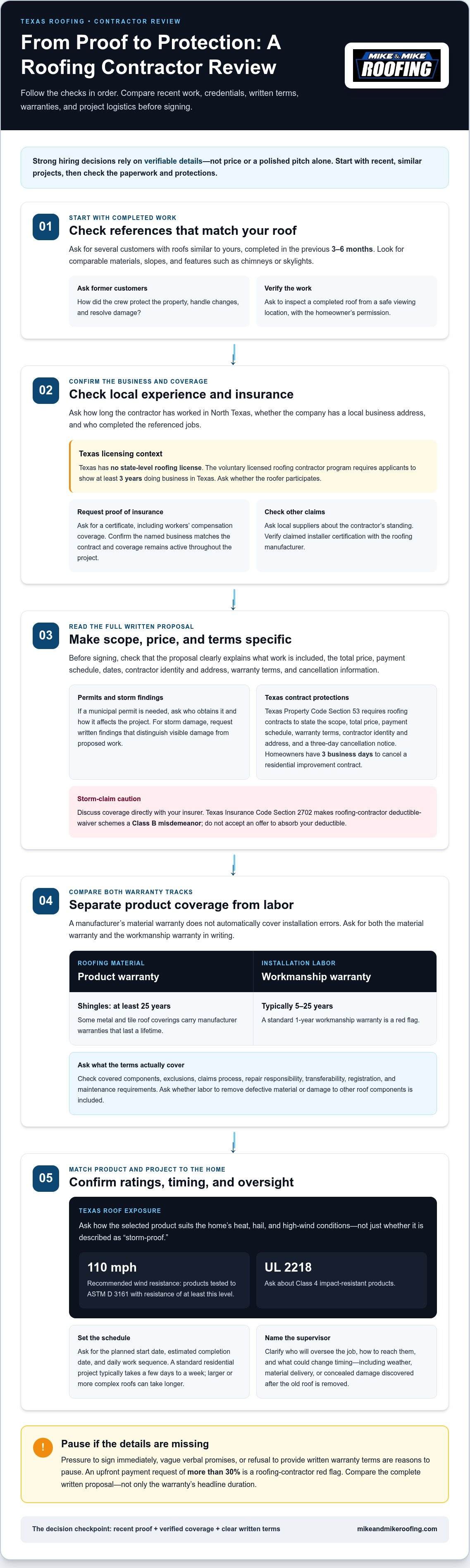
Start with evidence of completed work, not a polished pitch. Ask for references from several customers whose roofs resemble yours, then request jobs completed in the previous three to six months. Recent projects show how the roofer handles current materials, weather conditions, and the details of a roof installation. Ask whether you can inspect a completed roof from a safe viewing location, with the homeowner’s permission.
Texas has no state-level roofing license. The voluntary licensed roofing contractor program requires applicants to provide proof of at least three years doing business in Texas. Ask whether the roofer participates, and request proof of insurance, including workers’ compensation coverage. Ask for a certificate of insurance and confirm that coverage remains active throughout the project.
Make references specific. Ask how many years the contractor has worked in North Texas, whether the company has a local business address, and who completed the referenced projects. The North Texas Roofing Contractors Association recommends checking those details, including whether a roofer has only recently arrived after a storm. Contact former customers directly and ask how the crew protected the property, handled changes, and resolved any damage.
Look beyond photographs. Ask for references from roofs with similar materials, slopes, and features, such as chimneys or skylights. Ask local suppliers whether the contractor is in good standing, and check the roofing manufacturer’s website to verify any claimed installer certification. If the work needs a municipal permit, ask who will obtain it and how permit requirements affect the project.
Texas Property Code Section 53 requires roofing contracts to state the scope of work, total price, payment schedule, warranty terms, contractor identity and address, and a three-day cancellation notice. Texas law gives homeowners three business days to cancel a residential improvement contract. Texas Insurance Code Section 2702 makes roofing-contractor deductible-waiver schemes a Class B misdemeanor. For storm damage or an insurance claim, ask for written findings and a clear work scope; discuss coverage directly with your insurer, and don’t accept an offer to absorb your deductible.
Ask how the contractor documents storm damage, distinguishes visible damage from proposed work, and shares findings for your records. Review the certificate of insurance, confirm the named business matches the contract, and verify that coverage stays active during installation. These checks help you assess the contractor’s references and business information before choosing.
2. What Should I Look for in a Roofing Contractor?
Look for clear written terms, not a broad promise that “everything is covered.” A roof has separate warranty tracks: one for roofing materials and another for installation workmanship. Ask the contractor to show both documents before work begins. Compare the covered components, exclusions, claims process, and steps required to keep each warranty valid.
For a shingle roof, homeowners should expect a manufacturer’s warranty of at least 25 years. Some metal and tile roof coverings carry manufacturer warranties that last a lifetime. Those terms apply to the product, not automatically to labor or installation errors. Ask the manufacturer’s name, the exact material specified for my roof, and whether the contractor will provide written warranty information.
For Texas heat, hail, and high winds, ask which product ratings match the roof’s exposure. Roofing products tested to ASTM D 3161 with wind resistance of at least 110 mph are recommended for Texas roofs. Ask about UL 2218 Class 4 impact-resistant products, too. Have the contractor explain how the selected roofing material addresses the home’s conditions, rather than relying on a general claim that it is “storm-proof.”
Workmanship coverage is separate from manufacturer coverage. Roofing workmanship warranties typically last 5-25 years, and a standard 1-year workmanship warranty is a red flag. Ask what installation problems are covered, how to report a defect, and who handles repairs. Get labor and manufacturer warranty information in writing. Read the terms for exclusions, transferability, registration, and maintenance requirements, then keep the signed documents with your contract.
Ask what the warranty means in practical terms: Does it cover labor to remove defective material? Does it include damage to other roof components? What evidence is needed for a claim? A warranty should explain its limits in language you can understand. If a contractor offers a GAF Golden Pledge warranty, its stated 50-year material coverage and 25-year workmanship coverage apply when the contractor is GAF Master Elite.
Pressure to sign immediately, vague verbal promises, or refusal to provide written warranty terms are reasons to pause. An upfront payment request of more than 30% is a roofing-contractor red flag. Compare the written terms alongside the proposal, not just the warranty’s headline duration. A long product warranty can still leave labor costs or specific types of damage outside its coverage.
If your exterior plans also include siding, review its materials and written coverage as a separate part of the scope. Clear paperwork makes it easier to understand what protects each part of your home. For that work, explore siding contractor services alongside your roofing plans.
3. Project schedule and installation oversight
Before signing, ask for the planned start date, estimated completion date, and daily work sequence. A standard residential roofing project typically takes a few days to a week. Larger or more complex roofs can take longer. Ask what could change the schedule, including weather, material delivery, or concealed damage discovered after old roofing is removed. Have the contractor explain how schedule changes will be communicated.
For a standard 2,500-3,500 square foot asphalt-shingle roof in DFW, installation takes 1-2 days with a properly staffed crew. That example is not a schedule for every home. Roof size, design, access, repairs, and crew staffing affect the work. Ask for a timeline based on your roof’s specific scope, and clarify whether the dates describe working days or calendar days.
Project oversight needs a named point of contact. The North Texas Roofing Contractors Association recommends asking who will supervise the project, how experienced that person is, and how to contact them. Ask who answers schedule questions if the supervisor is on the roof. Agree on how you’ll receive updates, especially if weather shifts the start time or decking damage changes the work.
Ask how rain or unsafe working conditions affect the installation sequence. The roofer should explain how exposed areas will be protected if weather interrupts work and when crews will resume. Confirm how removed shingles and other debris will be handled each day. Ask how the crew will protect landscaping, driveways, and outdoor items, then agree on what cleanup should be complete before the crew leaves.
Permits and inspections belong on the schedule, too. Roofing permits are required in nearly every DFW jurisdiction. Ask who obtains the applicable municipal permit, when it will be secured, and who coordinates any required inspection. Get those responsibilities in writing, along with the expected start and completion dates. This prevents permit steps from becoming a surprise after materials arrive.
Use the written scope to understand project costs, not just a bare total. Ask how labor, materials, tear-off, disposal, decking repairs, and other listed work are accounted for. If damaged decking is found after removal, request a written description of the additional work and its effect on the schedule before it proceeds. The extent of damage and materials needed determine the change.
Ask when progress payments are due and what documentation accompanies each payment. Texas Property Code Chapter 53 allows roofing contractors unpaid for completed work to file a mechanic’s lien. Discuss what lien waivers apply to payments and when you’ll receive them. Keep copies of the contract, change approvals, permit records, payment receipts, and final completion documents together.
4. Reviewing written proposals before signing
Get a detailed written estimate before roofing work begins, then review the proposal before signing. A total without a defined scope makes it difficult to compare bids or understand what the roofer will replace. Check that the proposed work describes the roof areas involved, materials, removal, disposal, and how the crew will handle damage discovered during installation.
Texas Property Code Section 53 requires roofing contracts to state the scope of work, total price, payment schedule, warranty terms, contractor identity and address, and a 3-day cancellation notice. Compare each item against the proposal and ask for corrections in writing. Texas law gives homeowners 3 business days to cancel a residential improvement contract, and the contract must include written notice of that right.
Read the material description closely. A proposal should identify the roofing material and its relevant components, rather than relying on a vague label such as “standard shingles.” If the document uses product terms you don’t recognize, ask for plain-language explanations. Confirm that the written scope matches the product and installation details discussed with the roofer.
Review each cost line beside the work it covers. Look for clear entries for tear-off, replacement materials, underlayment, flashing, ventilation, disposal, and labor when those items apply to your roof. Ask how the estimate handles hidden damage or additional decking work. The proposal should explain how changes are documented and approved before extra work proceeds.
Check that payment terms connect to project progress. The payment schedule should be written, understandable, and consistent with the agreement. Ask what each payment covers and what records you’ll receive. Keep receipts and signed change approvals with the proposal. Written records help establish what was authorized if a dispute later concerns payment, workmanship, or liability.
Look for warranty terms that distinguish manufacturer coverage from workmanship coverage. The proposal should identify the warranty documents you’ll receive and describe any exclusions or required steps. Ask how the roofing contractor will protect your property during removal and installation, including how debris and any damage to surrounding areas will be handled.
Don’t sign a roofing document until you’ve had time to read every page. Check that names, address, scope, payment schedule, warranty terms, and cancellation notice are present and consistent. If asking for a revision, request a clean copy that includes the agreed language. Keep the final signed contract and proposal for your records, so the approved work is clear to you and the trained crew.
5. Finding a roofing contractor
Build your shortlist from evidence, not a truck sign or a storm-day pitch. Ask each roofer what credentials and insurance coverage they carry, and verify the details before work begins. A contractor described as licensed may have completed a voluntary licensing process that includes an application and exam. Treat that as one qualification, not a substitute for checking the contract, coverage, and completed work.
Use a consistent screen for each candidate. Confirm that the business name on its proposal matches its insurance certificate and other project documents. Ask for a certificate of insurance, including workers’ compensation, and verify coverage remains active during the work. Workers’ compensation can protect homeowners from liability for medical expenses if a crew member is injured on the property.
Local knowledge matters, but it should be specific. Ask how long the roofer has worked in your part of Texas, which local projects resemble yours, and what conditions shaped those jobs. Consider whether the contractor belongs to a roofing association that holds members to high standards. Membership is one useful factor to weigh alongside other evidence, not a replacement for it.
Look for a clear work plan that accounts for the roof’s details. Ask how the crew will handle flashing around chimneys, walls, and roof penetrations, and how it will protect landscaping and driveways. Discuss how workers will contain debris and leave the property at the end of the job. A contractor who explains the sequence in plain terms makes it easier to understand what will be done.
Compare proposals by scope and materials, not by the bottom line alone. If one bid omits flashing, disposal, or a clear process for hidden damage, ask for a written explanation before deciding. A low bid that doesn’t describe the same work isn’t a like-for-like comparison. Ask what changes require your approval and how the contractor records them.
Use a final pass before choosing: match the contractor’s identity across documents, review the coverage, compare the written scope, and consider the references. The Better Business Bureau and other consumer agencies receive thousands of complaints about roofing contractors each year. That figure is a reason to slow down and make a documented decision, not to assume every roofer is unreliable.
Choose the contractor whose answers are specific, whose paperwork is consistent, and whose planned work fits your roof. If you’re ready to discuss a roof project, start a conversation about your roofing needs.
Mike and Mike Roofing: Roof Installation
Mike and Mike Roofing offers roof installation for homeowners ready to move from comparing contractors to planning the work. If your roof needs replacement, use the questions in this guide to discuss materials, project scope, oversight, and written warranty terms. The company works with premium Owens Corning materials and has an A+ BBB rating and 5-star reviews. Its work also comes with industry-leading warranties.
Bring your priorities and questions about the roof’s condition to the conversation. Clear details about your home and planned work can help shape a proposal around the project, rather than a generic checklist. Mike and Mike Roofing also handles siding, window installation, and patio services when those exterior projects are part of your plans.
To discuss roof installation for your home, contact Mike and Mike Roofing.
Make Your Next Roofing Decision With Confidence
Your next step is to turn the conversation into a clear record of what matters to your home. Note the priorities shaping your decision, such as the roof’s condition, preferred materials, and how the work may affect your household. Use these questions to ask a roofing contractor in Texas to keep discussions focused, rather than making a decision before the details make sense.
A sound hiring decision should feel understandable on paper, not just persuasive in conversation. Take time to compare the proposed work with your needs, and choose a path you can explain clearly to anyone involved in caring for your home. If roof installation is the next step, contact Mike and Mike Roofing to discuss your project. You’re in a stronger position to move forward when the plan fits your home and you know what to expect.
Frequently Asked Questions
What Should I Look for in a Roofing Contractor?
Look for a contractor who can explain how the proposed roof system fits your home. Useful questions to ask a roofing contractor in Texas include how ventilation, flashing, and roof features affect installation. For a home in Weatherford, Fort Worth, or Aledo, compare proposals based on the same materials and roof details. Specific explanations help you understand what each bid covers and where the plans differ.
Are warranties an indication of how long my new roof will last?
No. A warranty describes protections under its written terms, but it doesn’t establish the exact service life of your roof. That depends on the installed system, workmanship, maintenance, and exposure to weather. Read the exclusions as well as the coverage period. Keep product and installation documents together so you can identify which warranty applies if a concern arises.
Can a secondary water barrier be installed before the new roof covering is installed?
Yes, a secondary water barrier can be included beneath a new roof covering when the roof design and selected system support it. Ask the roofer to identify the barrier in the written scope, state where it will be installed, and explain how it works with underlayment and flashing. For a Weatherford, Fort Worth, or Aledo home, make sure the proposal distinguishes this layer from the finished roofing material.
How Long Will the Roofing Project Take?
A typical composition roof replacement by Mike and Mike Roofing takes 1–3 days; metal roofs or complex framing may take longer. Weather, roof layout, material handling, and repairs discovered during tear-off can affect the schedule. Ask what must happen before installation starts and how the crew will protect exposed areas if conditions interrupt work. That helps households plan for noise, access, and vehicle placement.
How Much Will a New Roof Cost?
The cost depends on the roof’s size and pitch, decking condition, and selected shingles. These details affect material needs and labor, so a roof-specific estimate gives you a clearer basis for planning. Mike and Mike Roofing provides a free roof inspection with photos and a written estimate in its local service area, including Weatherford, Fort Worth, and Aledo. The estimate connects the proposed work to the roof’s actual condition.
How do I go about selecting a contractor to install my new roof?
Compare project plans, not just company descriptions. Use questions to ask a roofing contractor in Texas to clarify the specified roofing system, how the roofer will handle roof details, and what records you’ll receive at completion. Ask how changes discovered during installation are documented and approved. For homeowners in Weatherford, Fort Worth, and Aledo, specific answers help distinguish a plan tailored to the property from a generic recommendation.
What should a Texas roofing contract include, including scope, materials, payment terms, and warranty?
Texas Property Code Section 53 requires roofing contracts to state the scope of work, total price, payment schedule, warranty terms, contractor identity and address, and a 3-day cancellation notice. Texas law gives homeowners 3 business days to cancel a residential improvement contract, and the contract must include written notice of that right. Before signing, check that material specifications and agreed changes appear in the final document.


