

What if the window that looks best on paper still leaves you with drafts, sticky locks, or leaks? The difference often comes down to more than the glass. A home window replacement service should match the window to your home and install it with care, especially in North Texas, where summer heat puts frames and seals to the test.
If your energy bills keep climbing or your old windows are hard to open and secure, replacement can feel like a big decision. It’s reasonable to worry that rushed workmanship could create problems you’ll be living with long after the crew leaves.
This checklist covers the details that matter, from frame materials and energy ratings to accurate fitting, sealing, and a clean installation. Use it to assess what your project needs to improve comfort, curb appeal, and efficiency, and to discuss the work with confidence.
Key Takeaways
- Spot warning signs such as moisture between panes, frame rot, or windows that won’t stay open or lock securely.
- Compare frame materials by weighing maintenance, durability, and appearance against your budget.
- Look for careful, project-specific measurements and attention to the rough opening, where hidden rot can undermine a new installation.
- Use SHGC and U-factor ratings to assess how well windows suit North Texas heat and help manage indoor comfort.
- A dependable home window replacement service should value local accountability and clearly distinguish product coverage from workmanship coverage.
Identifying the Need: When to Call a Home Window Replacement Service
Windows are part of your home’s protective envelope, not just openings for light. Watch for condensation trapped between panes, soft or crumbling frame material, and paint that keeps peeling near the sill. Moisture between panes often points to a failed seal in an insulated glass unit. The sealed space is designed to limit heat transfer; Insulated Glazing explains how this construction works.
Test how each window operates. A sash that sticks, slides down after you raise it, or refuses to lock can be more than an everyday nuisance. It may leave gaps that admit outside air or compromise security. On a breezy day, close the window and move your hand slowly around the frame. A light tissue held near the edges can also reveal air movement. Don’t mistake a curtain shifting elsewhere in the room for a leak; check the sash and frame directly.
Failed seals can also let in traffic, wind, and neighborhood noise. If a closed window no longer softens familiar outdoor sounds, inspect the frame and seals for visible gaps or deterioration. One symptom alone doesn’t tell the whole story, but several signs together are a good reason to have the window assessed.
Structural Red Flags in North Texas Homes
In Weatherford, foundation movement can change the shape of an opening and leave a window out of alignment. Look for uneven gaps around the sash, difficulty latching, or cracks in the surrounding trim. These signs don’t prove the foundation is shifting, but they deserve attention, especially if similar changes appear elsewhere in the house.
Check the siding and trim near the frame for staining, bubbling, soft spots, or deteriorated caulk. Water can get behind exterior materials and damage the rough opening, the framing that supports the window. A small area of rot can spread, turning a window concern into a larger repair. A home window replacement service should assess the condition of the opening, not just the visible glass.
The Cost of Inaction: Energy Bills and Comfort
Single-pane glass and double-pane units with failed seals can make rooms harder to keep comfortable. To understand the pattern, compare utility bills from similar seasons and note changes in thermostat settings, household routines, and HVAC run time. These comparisons can’t isolate the windows’ exact share of energy use, but recurring hot or cold spots and longer cooling cycles can help identify a problem worth investigating.
In North Texas heat, a leaky window can let cooled indoor air escape while warm air works its way inside. The HVAC system then has to run longer to maintain the set temperature. Drafts near a window, uneven room temperatures, and persistent hot spots are practical clues. An assessment can help determine whether the glass, sash, frame, or surrounding opening is contributing to the discomfort.
Thermal bridging occurs when heat travels through a less-insulating part of the window assembly, creating uncomfortable temperature differences near the frame.
Evaluating Materials: Frame and Glass Options for Longevity
A window’s durability depends on the whole assembly: frame, glass, seals, and how each handles the local climate. In Weatherford, Fort Worth, and Aledo, long stretches of sun and sharp temperature swings put materials to work. Don’t choose by appearance alone. A suitable home window replacement service should help match the window to the home’s exposure, comfort needs, and budget.
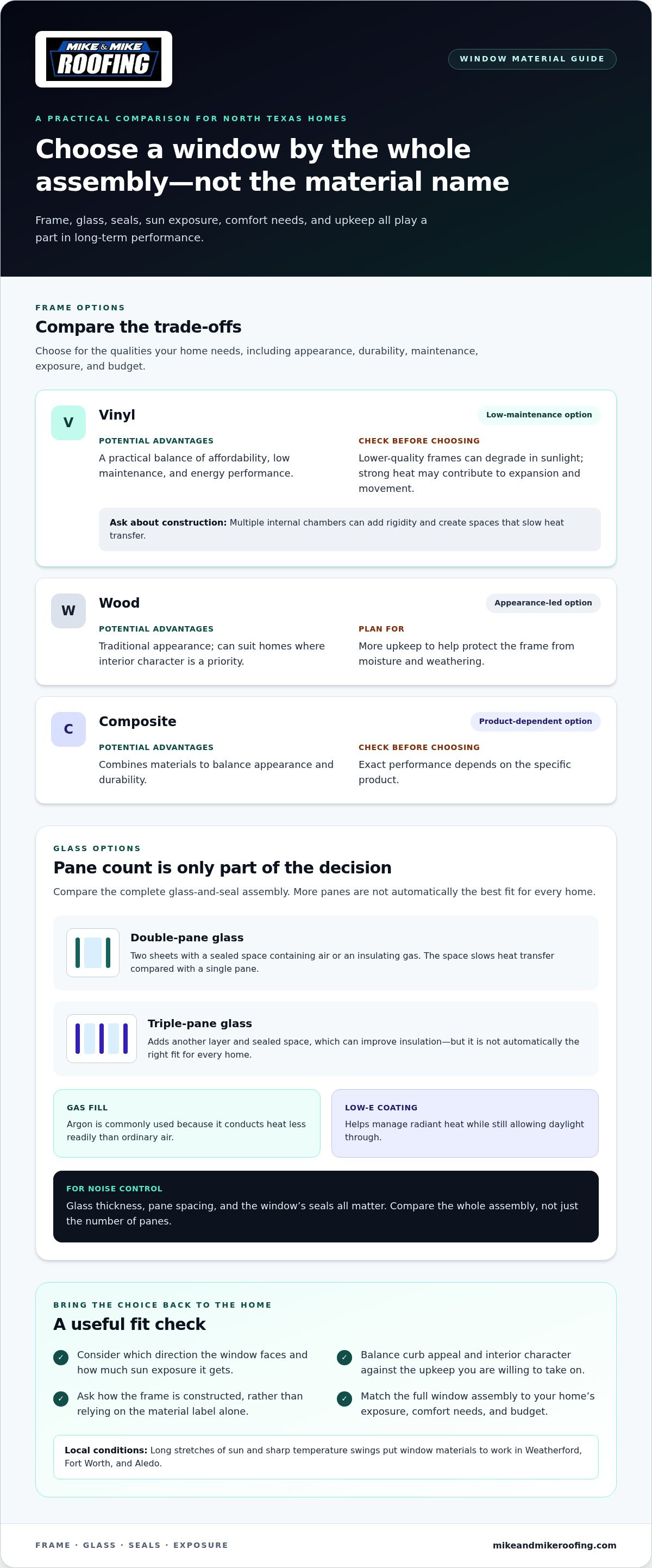
Vinyl is a practical choice for homeowners who want low maintenance and a balance of affordability and energy performance. But not all vinyl frames are built alike. Sunlight can degrade lower-quality materials over time, while strong heat may contribute to expansion and movement. Frame construction matters, too: multiple internal chambers can add rigidity and create spaces that slow heat transfer. Ask about the frame’s construction rather than relying on the material label alone.
Wood offers a traditional appearance and can suit homes where interior character is a priority, but it generally calls for more upkeep to protect it from moisture and weathering. Composite frames combine materials to balance appearance and durability, though the exact performance depends on the product. Choose based on the qualities your home needs, not a material name by itself.
Why Double Pane Window Replacement Is the Local Standard
Double-pane glass has two sheets separated by a sealed space. That space contains air or an insulating gas, creating a barrier that slows heat transfer compared with a single pane. Argon is commonly used as a fill because it conducts heat less readily than ordinary air. A double-pane unit may also use Low-E, or low-emissivity, coating. This thin coating helps manage radiant heat while still allowing daylight through.
For a closer look at how these units work, see this guide to double pane window replacement. Triple-pane glass adds another layer and sealed space, which can improve insulation, but it isn’t automatically the best fit for every home. For noise control, glass thickness, pane spacing, and the window’s seals all matter. Compare the complete assembly, not just the number of panes.
Frame Materials That Withstand the Texas Sun
UV exposure can leave inferior vinyl brittle, faded, or prone to distortion. Stronger frame construction and materials designed for sun exposure can help a window hold its shape over time. Composite and wood remain options when appearance is a priority, but consider maintenance and exposure alongside curb appeal. The right choice depends on which direction the window faces and how much upkeep you’re willing to take on.
Glass deserves attention beyond insulation, too. Low-E coatings help reduce solar heat entering sun-exposed rooms. For hail and wind, don’t assume that double or triple panes are impact-resistant. Ask about the glazing’s impact performance and how the complete window assembly is designed to handle local weather. A careful review of frame and glass options during a window replacement estimate can help you compare choices before settling on materials.
The Workmanship Checklist: What a Quality Installation Looks Like
A well-made window can still fail if it’s fitted carelessly. The frame must sit securely in a sound opening, and the joints around it must keep water and outside air from working their way indoors. That’s why a quality home window replacement service focuses on the opening and installation details, not just the new unit.
Before removing the old window, the crew should take and verify measurements for that specific opening. Windows that look alike can differ slightly in width, height, or squareness, especially in an older home. Accurate measurements help the replacement fit properly without forcing it into place or relying on oversized gaps and stacks of shims to make it appear secure.
Once the old unit is out, inspect the exposed rough opening, the framing that supports the window. This is the “bones” check. Soft, darkened, or crumbling wood can point to water damage. Damaged material needs to be addressed before the new window goes in; covering it with trim only hides a weakness that can continue to cause trouble.
Flashing and sealing protect the joint between the window and the surrounding wall. The installer should integrate flashing with the opening and exterior materials so water is directed away, not trapped behind the frame. After the window is set, low-expansion foam can fill the perimeter gap without putting excessive pressure on the frame. A rushed bead of caulk isn’t a substitute for sound flashing, a solid opening, and correctly placed insulation.
Step-by-Step Installation Integrity
Watch for a deliberate fit. The window should be level from side to side, plumb vertically, and square across its corners. These checks help the sash move smoothly and the lock engage as intended. Shims may be used to position and support a unit, but they shouldn’t compensate for a badly mismatched window or conceal a poor fit. The goal is a stable frame, not a forced one.
Exterior trim should sit neatly against the surrounding materials, with suitable caulk applied to exposed joints to help shed water. Before the crew leaves, test every sash: open it, close it, and engage each lock. Check for scraping, uneven gaps, or a sash that won’t stay in position. Small fit problems are easier to address while the installation work is still underway.
Red Flags to Watch For During Service
Pay attention if a crew appears to force a generic-sized unit into an opening with excessive shimming, skips checking for concealed rot, or leaves visible gaps around the frame. Insulation should fill the space evenly, not stop short at corners or leave open voids. If something doesn’t look right, ask for a clear explanation before trim hides the work. A straightforward conversation is part of a careful installation.
For homeowners in Weatherford, Fort Worth, and Aledo, a window estimate is a sensible time to discuss how measurements, the rough opening, flashing, and insulation will be handled. Mike and Mike Roofing’s window installation service includes free estimates, so you can review the project before work begins.
Energy Efficiency for the North Texas Climate
For homes in Weatherford, Fort Worth, and Aledo, window efficiency means managing both intense summer sun and heat moving through the glass and frame. Two ratings help you compare performance: Solar Heat Gain Coefficient (SHGC) and U-factor. SHGC measures how much solar heat passes through a window; a lower number generally means less heat enters. U-factor measures how readily heat transfers through the whole window, so a lower number indicates better insulation.
North Texas is in ENERGY STAR’s South-Central climate zone. Under Version 7.0 criteria, qualifying windows have a U-factor of 0.30 or lower and an SHGC of 0.25 or lower. Look for ratings certified by the National Fenestration Rating Council (NFRC), and compare both figures rather than choosing by a single efficiency label. A window with a low SHGC can help limit unwanted solar gain, while a lower U-factor helps slow heat transfer in either direction.
Professional sealing matters just as much as the glass. Gaps around a frame can allow outdoor air and moisture to enter, adding humidity to rooms and making indoor conditions harder to manage. Properly installed flashing, insulation, and exterior seals help close those pathways. For more guidance on selecting windows for local conditions, explore energy efficient window installation.
Fighting the 100-Degree Summer
Low-E glass has a thin coating that reflects some radiant heat while still admitting natural light. In a sunny room, the right glass can reduce solar heat entering through the window and help ease the cooling load. The benefit adds up across several windows, though actual utility use also depends on shade, window orientation, insulation, air leakage, and thermostat settings.
In Texas, the return on investment from energy-efficient windows comes through potential long-term energy savings and improved indoor comfort, balanced against the project’s upfront cost. No window can promise a specific bill reduction for every home. Compare ratings and consider which rooms receive the strongest sun.
Storm Readiness and Durability
During high winds, pressure differences can stress a window and its connection to the wall. A secure fit and sound fastening help the assembly perform as intended, while properly integrated flashing and intact seals help resist storm-driven rain. Window performance depends on both the unit’s design and the quality of its installation; one cannot make up for shortcomings in the other.
Weather around Weatherford can bring strong sun, heat, wind, and hail, so material choice should account for exposure and durability, not appearance alone. A home window replacement service should consider the window’s location and the demands on its frame, glass, and seals. For project-specific guidance, request a window estimate from Mike and Mike Roofing.
Choosing the Right Home Window Replacement Service
A window project is a commitment to your home’s exterior protection, so the estimate should be clear before work begins. Review the scope, materials, installation details, cleanup, and warranty terms, not just the final figure. A low estimate can leave out important work or fail to explain how the installation will be handled, so check that the written details match the project you discussed.
Local accountability matters, too. A business based in the Weatherford, Fort Worth, and Aledo area has a reputation to maintain close to home. A verifiable local address can make it easier to understand who you’re working with, while customer feedback can offer context about the experience. Mike and Mike Roofing is a father-son team based in Weatherford, with an A+ BBB rating and 5-star customer reviews.
Read warranty language carefully. Product coverage applies to the window itself and may address defects in materials or manufacturing. Workmanship coverage concerns installation labor and related issues. They’re not interchangeable. Before signing, make sure the written estimate explains which coverage applies, its duration, and how a claim is handled. For a practical framework for reviewing an installation service, see choosing the best window installation service.
Questions to Ask During the Project Discussion
A clear conversation should cover who will perform the work, how concealed rot will be addressed if it’s uncovered, and what the written scope includes. It should also explain how installation, cleanup, and warranty responsibilities are handled. These details help you understand the plan before the old window comes out, rather than sorting out surprises after the work is underway.
The Mike and Mike Difference: Family-Owned Integrity
Mike and Mike Roofing is a family-owned business operated by a father-son team. When discussing a window project, focus on the scope, suitable materials, and the steps involved in protecting the home. A clear explanation of the work helps you make a considered decision without feeling rushed.
A dependable proposal should make it easy to see what’s included and why each part matters. If the scope, materials, or warranty language is unclear, pause and get a plain explanation before moving forward. That’s a sensible way to protect your investment and choose a home window replacement service with confidence.
Ready to discuss your project in Weatherford, Fort Worth, or Aledo? Request your free window replacement estimate from Mike and Mike Roofing.
Take the Next Step Toward a Better-Fitting Home
Before choosing a home window replacement service, take a moment to define what you want the project to improve. Is the priority a quieter bedroom, a more comfortable living room, easier operation, or a cleaner look from the street? A clear priority helps turn a broad renovation decision into a focused conversation about the right options for your home.
Make a short list of the rooms you’re concerned about and the changes you’ve noticed. Bring it to your estimate discussion, along with any questions about the proposed scope, materials, or installation. You don’t need to have every technical detail figured out. You do deserve straightforward answers and a plan that makes sense for your house.
Mike and Mike Roofing is a family-owned, father-son business based in Weatherford, serving the local area. Take the next step and get your free window estimate. A clear plan can make the project feel manageable, and the right improvements can help your home feel more comfortable.
Frequently Asked Questions
How much does a home window replacement service typically cost in Weatherford?
There isn’t one reliable price for every Weatherford home; the project scope determines the estimate. The number and dimensions of windows, frame and glass selections, installation approach, and any concealed damage can all affect the work involved. A useful written estimate separates the windows from installation tasks and explains what happens if the scope changes after removal. That gives you a clearer basis for reviewing the proposed work and its cost.
Is it better to replace all windows at once or one at a time?
Replace them together if several windows are failing and a consistent appearance or one coordinated installation is important to you. A staged approach can make sense if only a few openings are problematic or you prefer to spread the project over time. If replacing in phases, keep a record of frame finishes, glass features, and window dimensions so later replacements can better match the first group.
How long does the average window installation take for a standard house?
There’s no dependable single duration for every “standard” house. The window count, access to each opening, removal method, weather, and condition of the surrounding construction can change the schedule. A project involving straightforward replacements may proceed differently from one that uncovers damage or needs additional carpentry. A written project plan should make clear which openings are included and how the installation will be sequenced through the home.
Can window replacement really lower my North Texas energy bills?
It can help reduce heat transfer and air leakage, but lower bills aren’t guaranteed. Results depend on the old windows’ condition, the replacement’s performance, installation quality, and other parts of the home, such as insulation and ductwork. Compare bills from similar seasons after the project, while accounting for changes in thermostat settings or energy use. The exact savings for an individual home can’t be predicted from window ratings alone.
What is the difference between a pocket installation and a full-frame replacement?
A pocket, or insert, installation places a new window inside the existing frame, preserving much of the surrounding trim. It can be suitable when the frame is sound and the existing opening doesn’t need major changes. A full-frame replacement removes the existing window and frame, exposing more of the opening. That approach can address frame damage or allow changes to the opening, but it involves more removal and reconstruction.
What should I look for in a window installation warranty?
Read the written terms and separate coverage for the window product from coverage for installation work. Look for what defects are covered, how to report a problem, any exclusions, and whether coverage can transfer if you sell the home. Keep the proposal, product details, and completion records together. Clear documentation helps you identify which party handles an issue, such as a glass defect versus a problem with the installation.
How do I prepare my home for a window replacement crew?
Clear furniture, decorations, and window coverings from the work area, then move fragile items away from nearby surfaces. Make a path from the entrance to each room and secure pets in a separate space. If windows are difficult to reach, clear access to the exterior as well. Before work starts, identify any delicate landscaping or household items near the openings so they can be protected during the project.
Do I need a permit for window replacement in the Fort Worth area?
Permit requirements can vary by municipality and by the work involved, so don’t assume the same rule applies throughout the Fort Worth area. Replacing a window within an existing opening may be treated differently from changing its size or altering the structure. Check with the building department responsible for your property before work begins, and keep any permit documents with your project records.


